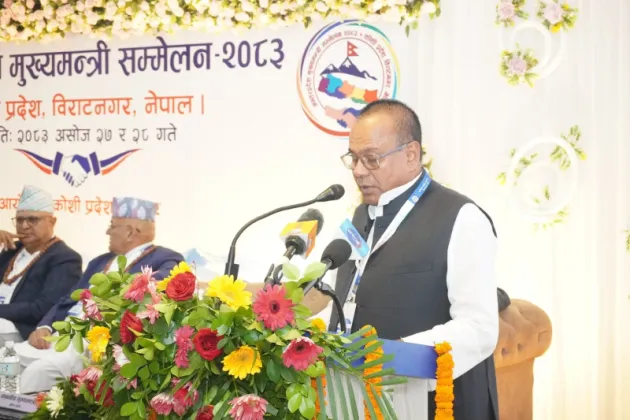
Bagmati Province Chief Minister Kiran Thapa Magar and Karnali Province Chief Minister Mangal Bahadur Shahi said Nepal’s federal system needs further strengthening at an inter-provincial chief ministers’ conference held in Biratnagar on Tuesday. Speaking at the gathering, Thapa Magar said federalism should not be understood simply as the transfer of powers from Singha Durbar to provincial capitals. He said its purpose should include improving citizens’ access to governance, shaping policies around local needs and making the system accountable. Shahi, meanwhile, said greater effort is needed to strengthen federalism, pointing to misconceptions about the system being created in the country.
Federalism beyond transferring authority
Thapa Magar’s remarks set out a broader measure of what federalism should deliver. In his view, moving authority from the central seat of government to provincial capitals is not, by itself, enough. The system also needs to make governance more accessible to citizens and allow policy decisions to reflect the needs of local communities.
That distinction places the focus on how federalism works for people, rather than on the location of government powers alone. Thapa Magar linked that purpose to accountability as well, describing it as an essential part of a federal system. His comments presented access, locally responsive policymaking and accountability as connected expectations of governance.
The message at the conference was therefore not limited to the formal arrangement of authority. Thapa Magar’s remarks suggested that the value of federalism should also be judged by whether people can access governance and whether policies address needs in their own communities. The conference brought those questions into discussion among provincial chief ministers, with the system’s implementation and practice now about ten years under way.
Calls for greater effort and clearer understanding
Shahi said much greater effort was required to strengthen federalism. He also cited what he described as various misconceptions being created in the country. His remarks drew attention to the public understanding of federalism alongside the work of reinforcing the system itself.
Taken together, the two chief ministers’ comments highlighted related concerns. Thapa Magar focused on what federalism should mean in practice for citizens and policymaking, while Shahi stressed the need for more work and raised the issue of misconceptions. Both statements presented federalism as a system that still requires attention, rather than one whose objectives have been fully met simply because it has been implemented.
The emphasis on misconceptions also places the debate over federalism in the realm of how the system is understood. Shahi’s comments did not, in the summary of the conference, identify particular misconceptions. His broader point was that such views are being created in the country and that strengthening federalism requires substantially greater effort.
A discussion about implementation
The Biratnagar conference took place about a decade into the implementation and practice of federalism. That timing gives added context to the remarks: the chief ministers were discussing not only the idea of federalism, but also the work of strengthening it after years of practice. Their statements centred on the expectations attached to the system and the challenges they believe remain.
Thapa Magar’s focus on citizens’ access, local needs and accountability describes practical goals for governance under federalism. Shahi’s call for greater effort and his concern about misconceptions add a further dimension, emphasising the need to reinforce the system and address how it is viewed. Neither set of comments reduces federalism to the transfer of powers alone; together, they underline that its purpose and public understanding remain part of the discussion.
The conference in Biratnagar thus brought forward a shared call for continued work on federalism, while the two chief ministers stressed different aspects of that work. Thapa Magar argued for a system that is accessible, locally responsive and accountable. Shahi said stronger efforts are needed amid misconceptions. Their remarks came as federalism entered roughly its tenth year of implementation and practice in Nepal.