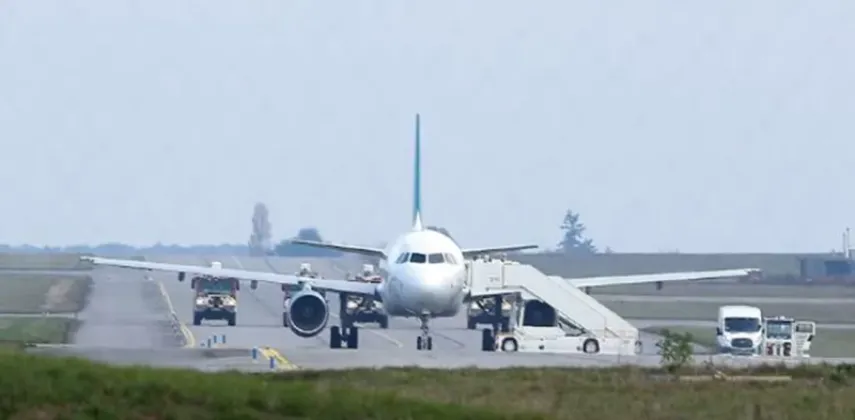
At least seven passenger aircraft flying across Europe were forced to make emergency landings on Thursday after receiving bomb threats, triggering heightened security alerts at airports across the continent. The affected planes, unable to continue to their scheduled destinations, were diverted to alternate airports in France, Bulgaria and Belgium, according to reports published by Rato Pati and Nagarik News. The string of threats, directed at multiple aircraft on a single day, has raised serious security concerns within the European aviation sector.
Seven Flights Hit by Threats in a Single Day
The bomb threats targeted at least seven aircraft operating in various European countries on Thursday, forcing each of them to abandon their planned routes. Passenger planes were compelled to land at airports other than their scheduled destinations, a precautionary measure that allows security agencies to respond to a threat before an aircraft is permitted to continue its journey.
Among the affected operators, an Irish airline company was also mentioned in the reports, although further details about the carrier, the number of its flights involved and the specific routes affected were not immediately disclosed. The fact that aircraft serving different countries were targeted on the same day has added to the sense of alarm, as the threats were clearly not confined to a single route, airline or national airspace.
The key facts established by Thursday's reports are as follows:
- At least seven aircraft across various European countries received bomb threats on the same day.
- The affected passenger planes were forced to make emergency landings at airports other than their scheduled destinations.
- The diversions were reported in France, Bulgaria and Belgium.
- An Irish airline company was mentioned among those affected.
- The incidents prompted heightened security alerts across the region.
Emergency Landings Across Three Countries
The most visible consequence of the threats came in the form of emergency landings in France, Bulgaria and Belgium. In each case, aircraft that had been bound for other destinations were diverted to airports within these countries, where they could be taken out of normal flight operations and dealt with under security procedures.
A diversion of this kind is among the most disruptive outcomes a commercial flight can face short of an actual onboard emergency. Aircraft are required to land at unfamiliar airports, often at short notice, while the flight is removed from its scheduled route entirely. The reports did not specify how many passengers and crew members were aboard the seven affected aircraft, nor how long the planes remained on the ground. Even so, any diversion of this nature inevitably disrupts the travel plans of everyone on board, as the flights concerned were unable to reach their intended destinations as planned.
Heightened Security and Concerns for European Aviation
The incidents have prompted heightened security alerts and raised broader concerns within the European aviation sector. Europe is one of the busiest aviation regions in the world, with a dense network of commercial flights crossing national borders every day, and threats directed at multiple aircraft within a single day represent an alarming development for airlines, airports and security agencies alike.
Bomb threats against commercial aircraft are treated with the utmost seriousness by aviation authorities, regardless of whether they ultimately prove credible. The safest course of action in response to a threat is to divert the aircraft and carry out security checks on the ground, exactly as happened with the seven flights on Thursday. While such measures prioritise the safety of passengers and crew, they also carry a significant operational cost, affecting airport schedules, airline operations and travellers across the countries involved.
The involvement of an Irish airline among the affected operators further underlines the cross-border reach of the threats. A single day of coordinated alerts was enough to force landings in three separate countries, demonstrating how quickly a security incident can ripple across a tightly connected air transport network.
Questions That Remain
Many questions remained unanswered in the immediate aftermath of Thursday's alerts. Neither report specified how the bomb threats were communicated, whether any explosive devices were found on board the aircraft or at the airports where the planes landed, or whether the threats were linked to one another. It was also not immediately clear whether any arrests had been made or which authorities would lead investigations into the incidents.
What is clear is that the events of Thursday have added a new layer of concern for European aviation. With seven aircraft diverted, emergency landings in France, Bulgaria and Belgium, and an Irish carrier among the affected operators, the incidents have served as a sharp reminder of the vulnerability of air travel to security threats and of the swift, costly response they demand. Further details are expected to emerge as the threats are assessed and the affected aircraft are cleared to resume operations.