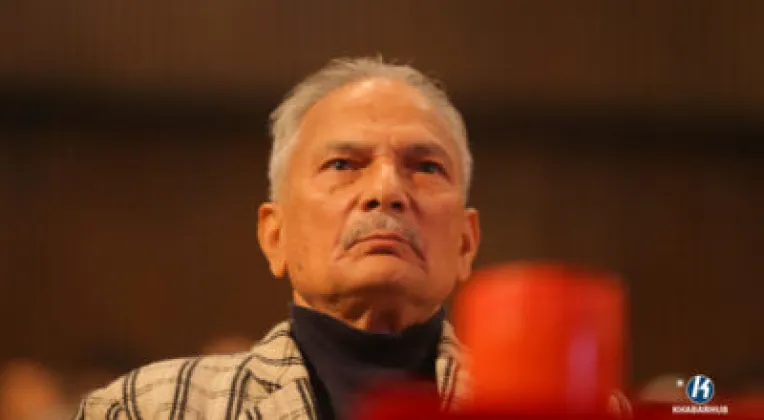
Former prime minister and Nepal Samajwadi Party chairman Dr. Baburam Bhattarai has welcomed the government's decision to grant principle approval to the Budhigandaki Development Authority Bill, a step aimed at advancing the Budhigandaki project, one of the country's national pride undertakings. In a statement posted on social media from Kathmandu, Bhattarai paired his endorsement with a sharp rebuttal to those who argue that recent disasters should discourage Nepal from building large reservoir projects, describing that line of reasoning as absurd. His intervention comes at a sensitive moment, as questions about dam safety and disaster risk have moved to the centre of public debate following devastating events in some of Nepal's key river systems, as reported by Khabarhub.
A Welcome for the Authority Bill
The principle approval granted by the government signals broad acceptance of the proposal to establish a dedicated development authority for the Budhigandaki project. An in-principle decision of this kind is an important stage in the lawmaking process, indicating that the government has endorsed the concept of the bill and allowing the proposal to proceed through the subsequent steps required before the authority can formally come into being.
For Bhattarai, the decision represents welcome momentum for a project he clearly believes Nepal should pursue. Welcoming the move, he said it would help advance the Budhigandaki project, which carries the national pride designation and is understood to be a large reservoir-based scheme intended to serve the country's broader development goals.
His remarks carry particular weight given his political standing. Bhattarai is a former prime minister and currently chairs the Nepal Samajwadi Party, and statements from leaders of his stature routinely shape discussion on infrastructure, federalism and development in Nepal. By publicly backing the bill, he has added a prominent political voice to the case for moving the project forward rather than letting it drift.
'Absurd' to Use Disasters as a Pretext
The most pointed element of his statement was his rejection of the argument that recent calamities justify stepping back from large reservoir construction. According to his social media statement, it is absurd to claim that large reservoir projects should not be built in Nepal by using the recent ice-rock avalanches and disasters in the Bhote Koshi, Trishuli and Budhigandaki rivers as a pretext.
In essence, Bhattarai's position can be summarised in a few points:
- He welcomed the government's principle approval of the Budhigandaki Development Authority Bill.
- He said the decision should serve to advance the Budhigandaki project, a national pride undertaking.
- He argued that the recent ice-rock avalanches and disasters in the Bhote Koshi, Trishuli and Budhigandaki rivers should not be used as a pretext to oppose large reservoir projects.
- He characterised the anti-reservoir argument as absurd rather than as a legitimate policy position.
The disasters he referenced struck river systems that sit at the heart of Nepal's hydropower ambitions. The Bhote Koshi and Trishuli are major river corridors, while the Budhigandaki is the river on which the national pride project itself is planned. In the aftermath of the recent avalanches and flood-related disasters, voices questioning the wisdom of building large storage infrastructure in the mountains have grown louder, and Bhattarai's statement amounts to a direct response to that strand of opinion.
The Reservoir Debate in a Fragile Landscape
The exchange touches a nerve because reservoir projects involve impounding very large volumes of water in a geologically young and fragile Himalayan landscape. Reservoir schemes are designed to store water and release it to generate electricity steadily through the year, a capability that run-of-river projects, which dominate Nepal's current fleet, do not offer. That is precisely why storage projects such as Budhigandaki have been accorded priority status and why their fate is watched so closely by policymakers and the public alike.
At the same time, the recent avalanches and disasters in the Bhote Koshi, Trishuli and Budhigandaki rivers have reminded the country how violently mountain environments can change, fuelling anxiety about what large dams could mean if similar events were to occur near major infrastructure. It is against this backdrop that Bhattarai has drawn his line: tragic events in the rivers, in his view, should not be converted into a blanket argument that Nepal must not build large reservoir projects at all.
His framing effectively shifts the question from whether such projects should be built to how the country should proceed with them. By calling the anti-reservoir argument absurd, he has sought to separate genuine concern about disaster preparedness from what he sees as an opportunistic case for abandoning storage infrastructure altogether.
What Comes Next for Budhigandaki
With principle approval secured, the Budhigandaki Development Authority Bill is expected to move through the remaining stages of the legislative process, after which the authority it envisions would be tasked with taking the national pride project forward. The government's endorsement of the bill's concept suggests that the project remains firmly on the state's agenda.
Bhattarai's statement makes clear that he intends the recent disasters to be read as a challenge to be managed, not as a reason to slow down. As the bill advances, the debate he has joined, over how Nepal balances its ambitions for large reservoir development against the realities of a disaster-prone landscape, is certain to continue, and his intervention has ensured that the case for proceeding with Budhigandaki will be argued at the highest level of national politics.