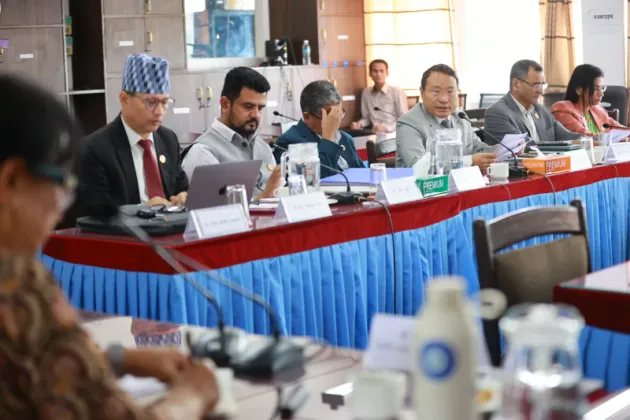
Nepali Communist Party lawmaker Barshaman Pun questioned proposed ambassador to Germany Saru Joshi on Tuesday about how Nepalis living abroad could exercise their voting rights and how the safety of labour destinations could be addressed, during a meeting of the Parliamentary Hearing Committee. Pun specifically asked whether Nepalis overseas would be able to vote in the upcoming local elections. Joshi said she would coordinate with the relevant bodies to facilitate the registration and verification of eligible voters abroad.
Questions on voting from abroad
Pun’s question put the practical issue of overseas voting before the committee: whether Nepalis living outside the country could take part in the next local elections. The meeting’s account did not establish that voting from abroad would be available in those polls. Instead, the question sought Joshi’s plans for helping Nepalis overseas access that right, should the necessary arrangements be made.
Joshi’s response focused on coordination. She committed to working with relevant bodies to facilitate the registration and verification of eligible voters abroad. Those steps are central to identifying who is entitled to vote and confirming voter eligibility, though the report did not set out a registration process, a timetable or a decision on how overseas ballots would be cast.
The exchange therefore addressed a commitment to work toward the administrative steps involved, rather than confirming that Nepalis abroad will be able to vote in the upcoming local elections. Whether that can happen remains unresolved in the information reported from the committee meeting.
Labour destination security also raised
Pun also asked about the security of labour destinations for Nepalis living abroad. The question brought the safety of places where Nepalis go for work into the discussion alongside voting rights. Joshi’s reported commitment was to coordinate with relevant bodies on voter registration and verification; the account did not provide a separate response or specific plan on labour-destination security.
The two issues raised by Pun concern different aspects of the relationship between Nepalis abroad and the state. Voting rights involve determining who is eligible and how participation can be arranged. The security question concerns the destinations where Nepalis work. The committee exchange, as reported, recorded the questions but did not provide detailed measures on either the conduct of overseas voting or the protection of workers at labour destinations.
Joshi’s commitment and what remains open
Joshi’s pledge to coordinate with relevant bodies identifies cooperation as the next step on registration and verification. However, no participating agencies, procedures or deadlines were specified in the reported account. Nor did it confirm whether the work would lead to a voting arrangement in time for the upcoming local elections.
Pun’s questions placed the concerns of Nepalis abroad before the Parliamentary Hearing Committee as it heard from Joshi, the proposed ambassador to Germany. The discussion covered both the possibility of voting from overseas and the security of labour destinations, while Joshi’s stated commitment addressed coordination on voter registration and eligibility checks. The immediate question of whether overseas voting will be possible in the next local elections was not answered definitively in the account of the meeting.