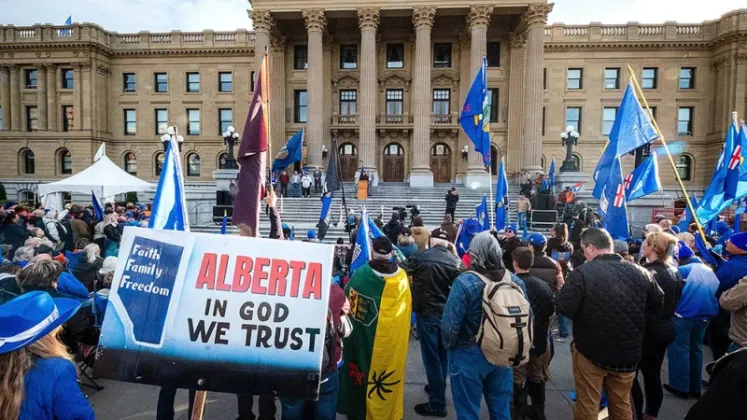
Alberta voters have delivered a decisive rejection of a proposal to move forward with a referendum on separating from Canada, with roughly 76 percent of ballots cast in opposition as more than one million votes were counted. The vote, held in Canada's oil-rich western province, put a starkly worded question to the electorate: should Alberta remain part of Canada, or should it leave? By a margin of roughly three to one, voters came down on the side of staying, handing a clear victory to those who want the province to remain within the Canadian federation. According to a report by Global Aawaj, the outcome stalls the push by independence advocates to advance a formal secession referendum.
A clear verdict at the ballot box
The question placed before voters left little room for interpretation. Rather than an abstract discussion about the province's future, the ballot framed the choice in the bluntest possible terms: whether the province should remain part of Canada or leave the country altogether. Voting took place on precisely that question, requiring every participant to take a position on the most fundamental issue a province can face.
When the counting was done, the result was unambiguous. About 76 percent of the more than one million votes counted were opposed to the proposal, a share that forecloses, at least for now, the prospect of the province moving ahead with a referendum on separation. The sheer volume of participation, with the count surpassing the one million mark, underlined how seriously Albertans treated a question that touched on the province's very identity and its place in the country.
The result at a glance
- About 76 percent of votes counted were opposed to the proposal to move forward with separation
- More than one million votes were counted in the final tally
- The ballot asked whether Alberta should remain part of Canada or leave
- The outcome represents a rejection of the push to advance a referendum on secession
Polling had pointed in the same direction
The lopsided result did not arrive without warning. An Ipsos-Global News survey conducted ahead of the vote had indicated that around 70 percent of Albertans favoured staying with Canada, a finding that closely foreshadowed the final count. If anything, the actual result ran somewhat more strongly in favour of the federation than the polling suggested, with the roughly 76 percent opposed edging past the seven-in-ten figure measured by surveyors.
For the independence movement, the numbers expose a sobering gap between the campaign's ambitions and the broader public mood. Its supporters succeeded in forcing a provincewide question, but they were unable to come anywhere close to a majority even for the intermediate step of moving toward a referendum on leaving Canada.
Alberta's place in the federation
Alberta is frequently described as Canada's oil-rich province, and the energy wealth at the heart of its economy has long coloured debates about how the region fits within the country. The referendum question pulled that conversation out of the political background and placed it directly before voters, asking them to weigh whether their province's future lies inside the Canadian federation or beyond it.
The emphatic answer amounts to a recommitment to that federation. By turning back the proposal by such a wide margin, Alberta's electorate has signalled that, whatever currents of discontent run through provincial politics, a decisive majority is not prepared to endorse taking the province down the road to secession. The vote does not erase the disagreements that gave rise to the question, but it does establish clearly where Albertans stand when the issue is put to them directly.
Separatists show no sign of standing down
If the result was a heavy defeat for the independence cause, it was not treated by its supporters as a final one. Despite the scale of the loss, supporters of independence have not backed down, and their refusal to concede the broader argument suggests the debate over Alberta's place in Canada will not simply vanish with the ballot count.
That persistence matters, because the movement has demonstrated it can place a question of national significance before a mass audience. More than one million voters engaged with the issue, and even a defeat of this magnitude leaves the underlying advocacy intact. Whether the movement can translate that persistence into broader support is now the central question facing its backers.
What comes next
For the moment, the machinery of a secession referendum has been stopped in its tracks. The proposal to move forward was rejected, and the province remains, by an emphatic popular vote, part of Canada.
Independence supporters say the campaign will continue; the wider electorate, on this evidence, remains unpersuaded. As the count showed, roughly three in four of the more than one million voters who took part chose to keep Alberta inside the federation, a verdict that will shape the terms of the debate as the province's separatists regroup and weigh their options.