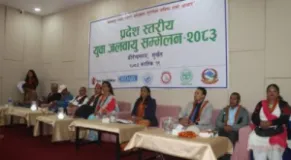
The federal government has handed over the implementation of agricultural, herbal and livestock insurance to the provincial governments, shifting responsibility for one of Nepal's key farm safety nets closer to the communities it is meant to protect. The programme is designed to reduce the economic losses that farming and livestock businesses suffer from natural disasters, disease and other risks, and it is backed by state subsidies of up to 80 percent on insurance premiums. According to a report by RatoPati, the provincial governments are now responsible for implementing the three schemes.
With the handover, the practical work of carrying the programme to the field, from enrolling farmers and herders to working with insurers and raising awareness, now rests with the provincial administrations across Nepal's seven provinces. The subsidy facility, under which the government has been paying up to 80 percent of the premium on crops, medicinal herbs and livestock, remains a central feature of the scheme and is intended to keep the cost of cover within reach of small producers.
Insurance delivery moves to the provinces
The decision transfers the implementation of three related insurance lines to the provincial level:
- Agricultural insurance, aimed at farmers engaged in crop production
- Herbal insurance, covering the cultivation of medicinal herbs
- Livestock insurance, for households and businesses that rear animals
Although the three schemes serve different kinds of producers, they share a single purpose: to reduce the financial damage caused by events that farmers cannot control, whether natural disasters, outbreaks of disease or other risks. Extending that protection is the stated objective of the government programme, and the provinces are now the level of government charged with delivering it.
The handover also places the schemes squarely within Nepal's federal structure, in which provincial governments sit between the federal centre and the local level. Assigning implementation to the provinces brings the administration of the programme closer to farming communities, which is where enrolment, coordination with insurers and awareness-raising will actually take place.
Up to 80 percent of the premium paid by the state
At the heart of the scheme is the premium subsidy. The government has been providing subsidies of up to 80 percent on insurance premiums, which means a farmer insuring crops, herbs or livestock may pay as little as one-fifth of the cost of a policy, with the state covering the remainder. For smallholders, for whom even a modest outlay can be a barrier, that support is what makes formal insurance an affordable option rather than a distant one.
Subsidised cover of this kind serves a dual purpose. It lowers the barrier to enrolment, encouraging more farmers to take out policies, and it ensures that when a shock arrives, an insured producer can claim compensation rather than absorbing the full loss. That, in turn, helps farming and livestock businesses recover and continue operating, cushioning precisely the economic losses the scheme was created to reduce.
Reducing losses from disasters and disease
The rationale for the programme lies in the exposure of agriculture to risk. Farming and livestock businesses can suffer heavy losses from natural disasters, disease and other hazards, and for a household that depends on its fields or its animals, a single such event can erase the income of an entire season. Insurance works by spreading that risk: many policyholders pay premiums into a common pool, and those who suffer a covered loss receive compensation from it.
By assigning the three schemes to the provinces while maintaining the subsidy of up to 80 percent, the government's stated aim is to reduce the economic losses facing crop farmers, herb growers and livestock keepers. Taken together, the three insurance lines extend that protection across the main branches of agricultural enterprise the programme covers, from crops in the ground to herbs under cultivation and animals on the farm.
What the handover means going forward
With implementation now in provincial hands, the reach of the scheme will depend on how actively the provinces enrol farmers, coordinate with insurers and make producers aware of the subsidised cover available to them. The subsidy gives provincial governments a strong instrument for that task, since a farmer's cost of joining the scheme is a fraction of the full premium.
The direction of policy is nonetheless clear: the risks confronting Nepal's farmers and livestock keepers are to be managed through insurance, with the provinces on the front line of delivery and the federal government continuing to meet up to 80 percent of the premium. For farmers and herders across the country, the provincial governments are now the bodies responsible for putting that protection into practice.