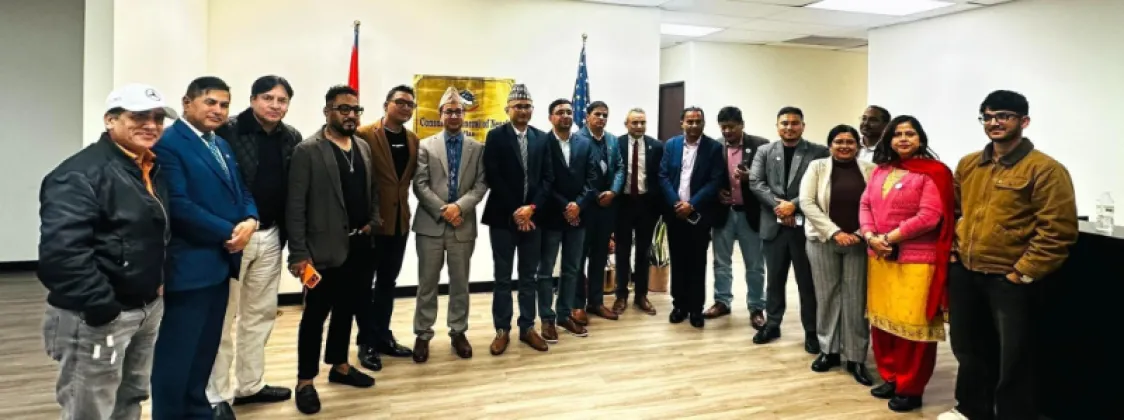
Nepal's Acting Ambassador to the United States, Sharad Raj Aaran, has said that the Nepali Embassy in Washington aims to expand friendly relations between Nepal and the United States by mobilising the Nepali diaspora living across America. Aaran made these remarks during a meeting with journalists and members of the local Nepali community, organised by the Nepali Consulate General in Texas on Tuesday.
He underlined that the embassy sees the diaspora not merely as a community to serve, but as an active partner in advancing Nepal's diplomatic interests in the United States.
Diaspora as a Diplomatic Bridge
Speaking at the interaction, Aaran said Nepalis residing in areas with large community populations can play a direct role in building access to American lawmakers. According to him, members of the community who live in the constituencies of congressmen and senators are well placed to establish contact with them and to convey Nepal's concerns and priorities.
This approach reflects the reality of American politics, where elected representatives are often most responsive to voters from their own districts and states. By engaging community members in states such as Texas, where the Nepali population has grown significantly in recent years, the embassy hopes to create channels of communication with members of the US Congress that go beyond formal, embassy-level diplomacy.
The Acting Ambassador's comments suggest that the embassy's strategy is to make the diaspora a bridge between the two countries: a community rooted in Nepal, but integrated into American civic life, and therefore able to speak to American institutions in ways that diplomats alone cannot.
Engaging Journalists and the Community
The meeting in Texas, organised by the Nepali Consulate General, brought together Nepali journalists and community members for a direct interaction with the senior diplomat. Such interactions have become a common way for Nepali missions abroad to stay connected with migrant communities, hear their concerns and share information about the embassy's work.
Aaran's emphasis on the media alongside the community points to the role Nepali-language and diaspora-focused news outlets play in the United States. These outlets help keep hundreds of thousands of Nepalis informed about developments at home and in their adopted country, and they also amplify community issues that may otherwise go unheard.
While the summary of the event does not detail the specific questions raised by journalists or the grievances voiced by community members, the very format of the meeting indicates an effort by the mission to maintain open lines of communication with a diaspora that has become one of the most visible immigrant communities in many American states.
A Growing Community With Growing Influence
The Nepali community in the United States has expanded rapidly over the past two decades, driven by migration for education, employment and family reunification. States such as Texas have seen notable growth in Nepali-owned businesses, community organisations and cultural institutions.
It is against this backdrop that Aaran's remarks should be read. A larger and more settled diaspora means more Nepali voters, taxpayers and constituents, and therefore more potential influence on local and national politics in the United States. Community members who are citizens can vote, campaign and lobby, and they can approach their representatives on issues ranging from immigration policy to bilateral relations between Kathmandu and Washington.
By pointing to access to congressmen and senators, the Acting Ambassador highlighted one of the most practical avenues through which a diaspora can affect foreign policy. Members of Congress respond to constituents, and constituents of Nepali origin are increasingly present in districts across the country.
The Embassy's Broader Approach
Aaran's statement positions diaspora engagement as a pillar of the embassy's work to strengthen Nepal-US relations. The two countries share a long history of friendly ties, and the United States has been a major destination for Nepali students and migrants as well as a significant partner in development cooperation.
Using the diaspora to expand these relations represents a shift toward people-centered diplomacy, in which non-state actors, including migrant communities, become participants in the bilateral relationship rather than bystanders. For a country like Nepal, whose formal diplomatic presence in the United States is limited to its embassy in Washington and a small number of consulates, the leverage offered by an engaged diaspora can be substantial.
The consulate's role in Texas is part of this broader structure. Nepali consulates in the United States handle community services and consular matters for Nepalis in their regions, and interactions like Tuesday's meeting allow officials to combine those functions with outreach on wider diplomatic goals.
Looking Ahead
The Acting Ambassador's remarks signal that the Nepali Embassy in Washington intends to deepen its cooperation with Nepali community organisations and individuals across the United States in the period ahead. Whether through formal interactions with journalists and community leaders, or through the informal networks that connect Nepali families with their local representatives, the message from the Texas meeting was clear: the diaspora is being invited to take an active part in shaping the future of Nepal-US relations.
For community members in Texas and beyond, the invitation represents an opportunity to translate their growing numbers into growing influence, both for themselves and for the country they continue to call home.
More details on the interaction are available in the original report published by Nepal Press.