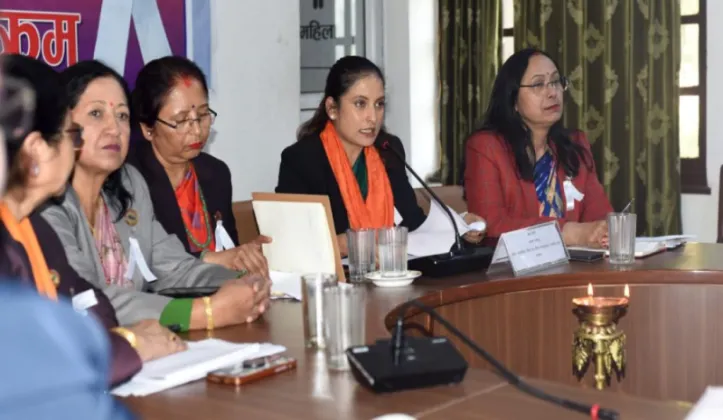
Kathmandu has once again become the centre of a global movement against gender-based violence as the Ministry of Women, Children, Gender and Sexual Minorities and Social Security of the Nepal Government formally launched the 16 Days of Activism against Gender-Based Violence in the capital. The campaign, observed worldwide every year, was inaugurated in Kathmandu with a call for collective action to end violence against women and girls across the country.
The launch was held under a distinctly Nepali national slogan: "Solidarity for Ending Gender-Based Violence: Protection of Victims, End of Impunity and Ensuring Justice." The slogan captures three pillars that the government and civil society partners hope will guide this year's campaign - standing with survivors, holding perpetrators accountable, and making justice accessible to those affected by violence.
A Global Campaign with a National Focus
The 16 Days of Activism is an international campaign that runs from November 25, the International Day for the Elimination of Violence against Women, to December 10, International Human Rights Day. The period deliberately links violence against women with human rights, underscoring the principle that no society can claim to protect human rights while its women and girls live under the threat of violence.
In Nepal, the Ministry of Women, Children, Gender and Sexual Minorities and Social Security has taken the lead in coordinating the campaign each year, bringing together government bodies, civil society organisations, development partners and the public. The Kathmandu launch serves as the starting point for activities across the country during the 16-day period.
This year's national slogan places particular emphasis on two persistent problems in Nepal's response to gender-based violence: the protection of victims and the culture of impunity. Advocates have long pointed out that while laws against domestic violence, trafficking and other forms of abuse exist on paper, survivors often struggle to access shelter, psychosocial support and timely justice. At the same time, many perpetrators continue to escape punishment, weakening public confidence in the justice system.
Launch Marked with Photo Feature and Call for Unity
The launch event in Kathmandu was marked with a photo feature, giving visual expression to the campaign's message and the realities of gender-based violence. Such visual storytelling has become an important part of the campaign, helping to bring issues that are often hidden within homes and communities into public view.
The event also carried a clear call for unity. Organisers stressed that ending gender-based violence cannot be the responsibility of the government alone. It requires the combined effort of families, communities, schools, workplaces, local governments and every citizen. The message of solidarity reflected in this year's slogan is meant to mobilise that broad base of support throughout the 16-day campaign and beyond.
From Awareness to Results
Commentary accompanying the campaign has emphasised that awareness alone is not enough. An editorial published in Nagarik News argued that a result-oriented campaign against violence is necessary, calling for the 16 Days of Activism to translate into measurable outcomes rather than remaining a symbolic exercise.
The concern reflects a broader debate in Nepal about how annual campaigns are conducted. While events, rallies and media features succeed in drawing attention each year, critics argue that the real test lies in whether reports of violence lead to protection for victims, investigation of cases, prosecution of offenders and lasting support for survivors.
The national slogan chosen for this year - with its focus on protection of victims, end of impunity and ensuring justice - is widely seen as an acknowledgment of exactly these gaps. By placing justice and accountability at the centre of the campaign, the Ministry has signalled that the emphasis this year goes beyond raising awareness and points toward concrete systemic change.
The Road Ahead
As the 16 Days of Activism unfolds across Nepal, attention will turn to how the commitments made at the Kathmandu launch are carried through at the federal, provincial and local levels. Local governments play a critical role, as they are often the first point of contact for victims of violence and are responsible for operating shelters, helplines and complaint mechanisms.
The campaign's success will ultimately be measured not by the events held during its 16 days, but by whether victims feel safer to report violence, whether cases move through the justice system without undue delay, and whether impunity for perpetrators begins to decline. For now, the launch in Kathmandu has set the tone: ending gender-based violence in Nepal is a shared responsibility, and the demand is clear - protect the victims, end the impunity, and ensure justice.
Further details about campaign activities and coverage are available through Gorkhapatra Online and Nagarik News.