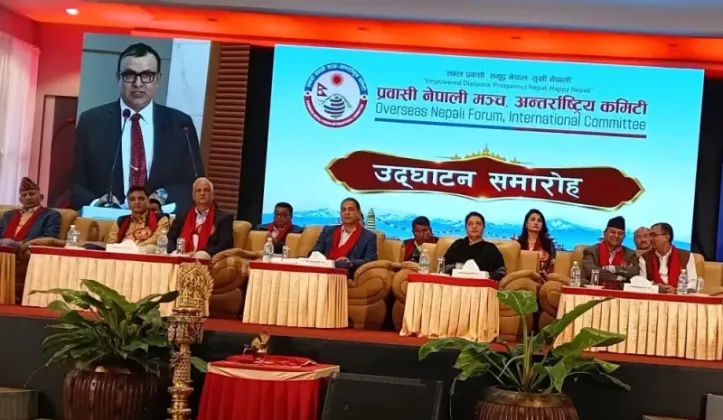
Senior CPN-UML leader Vidya Bhandari has said that the rumours, misinformation and confusion being spread about the party must be rebutted on the basis of facts and evidence, arguing that unfounded narratives should be answered with truth rather than allowed to stand unchallenged. She made the remarks while addressing the second convention of the International Committee of the Non-Resident Nepali Forum, organized in Kathmandu on Wednesday. Alongside her call for a fact-based response to misinformation, Bhandari reaffirmed that the party has been moving ahead under the guidance of people's multi-party democracy and stressed the need to understand and address the problems and needs of Nepalis living around the world.
Countering Rumours with Facts and Evidence
Speaking to the gathering in Kathmandu, Bhandari devoted a significant part of her address to the narratives circulating about the CPN-UML. She said that misconceptions, rumours and confusion spread about the party should be refuted on the basis of facts and evidence. The remarks were reported by Ratopati, which highlighted her call for misconceptions and rumours about the party to be refuted with facts and evidence, and by Nepal Press, which similarly emphasized her demand that rumours about the UML be answered on the basis of evidence.
At the heart of her address were three interlinked messages, as reflected in the coverage of her speech:
Three Key Messages from Bhandari's Address
- Rebuttal through evidence: Rumours, misinformation and confusion spread about the party must be answered on the basis of facts and evidence.
- Ideological continuity: The CPN-UML has been moving ahead under the guidance of people's multi-party democracy.
- Diaspora focus: The problems and needs of Nepalis around the world must be understood and addressed.
By framing the response to misinformation in terms of facts and evidence, Bhandari presented verification as the party's first line of defence. Rather than dismissing critical narratives outright, her argument was that such narratives should be met point by point, with documented truth serving as the rebuttal. The position places a premium on accuracy within the party's own communication, implying that counter-claims or exaggeration are no substitute for substantiated information. As a senior leader of the party, her words at a public platform of this kind carry particular weight within the UML's ranks and among its well-wishers.
Reaffirming the Party's Ideological Course
The second thread of Bhandari's address concerned the party's direction. She told the convention that the CPN-UML has been moving ahead under the guidance of people's multi-party democracy, presenting the doctrine as the framework that continues to steer the party. The statement functioned as a public reiteration of the party's ideological identity, delivered not at an internal gathering but before an audience of non-resident Nepalis and their representatives assembled in Kathmandu.
For listeners at the convention, the reassurance carried a double meaning. It affirmed to party members and supporters that the organization remains anchored to its guiding principles, and it signalled to the wider audience that the party's international outreach rests on the same ideological footing as its domestic politics. By pairing the ideological reaffirmation with her warning about rumours, Bhandari drew a direct connection between the party's stated principles and the manner in which she believes it should be judged: through facts, and through the doctrine it identifies as its guide.
A Platform for Nepalis Around the World
The setting of the address was itself significant. Bhandari spoke at the second convention of the International Committee of the Non-Resident Nepali Forum, a gathering held in Kathmandu that placed the concerns of the global Nepali community at the centre of discussion. The fact that the committee was convening for the second time underlines the continuity of the forum's work in connecting Nepalis abroad with political and social developments at home. It was before this audience that she stressed the need to understand and address the problems and needs of Nepalis around the world.
Her emphasis presented the diaspora not simply as an audience to be addressed, but as a constituency whose difficulties and demands deserve systematic attention. By calling on the party to understand these problems before attempting to address them, her formulation suggested a sequence that begins with listening: identifying what non-resident Nepalis actually face, and only then shaping responses to match. For a forum dedicated to non-resident Nepalis, the message aligned squarely with the purpose of the convention itself.
Taken together, Bhandari's remarks in Kathmandu conveyed a dual message. Within the country, the party's answer to rumour and confusion should be a disciplined, evidence-based rebuttal. Beyond Nepal's borders, the party's engagement with Nepalis abroad should begin with an honest accounting of their problems and needs. Delivered on the same Wednesday, before the same international audience, the two messages reinforced one another: a party confident in its facts and its ideology, and attentive to the community that links Nepal to the wider world.