
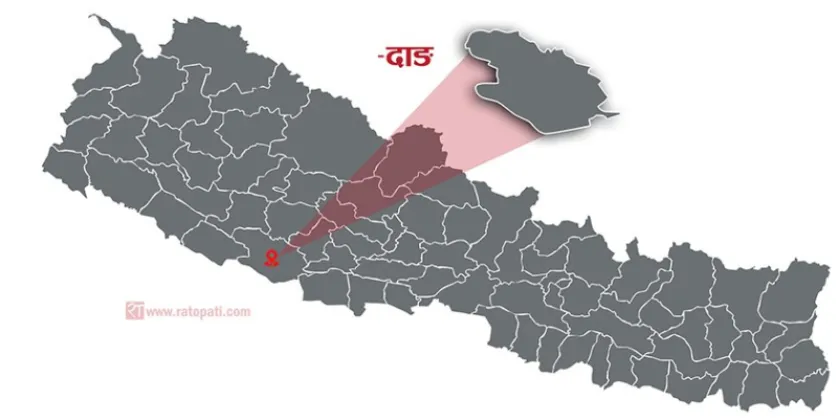
The Land Survey Office in Tulsipur, Dang collected more than Rs 4.8 million in revenue during the last fiscal year 2082/83, the office has confirmed. According to the office's information officer, Prem Bahadur Khadka, the total collection for the year stood at Rs 4,807,465, drawn from the sale of maps, charges for field surveying and plot consolidation services, and a range of administrative service fees. Alongside the revenue figure, the office also reported a complete record on application disposal, stating that all 1,173 applications for field book transfers and all 54 applications for area verification received during the year were completed.
Breaking Down the Revenue
The office's annual collection was recorded under three main heads, with the details as follows:
- Field surveying and plot consolidation services: Rs 2,484,265
- Map sales: Rs 2,229,475
- Other administrative service fees: Rs 93,725
- Total revenue: Rs 4,807,465
Field surveying and plot consolidation work emerged as the single largest contributor, bringing in Rs 2,484,265, which works out to slightly more than half of the year's total collection. These are the services landowners seek when plots need to be measured on the ground, when a holding is to be subdivided among heirs or buyers, or when adjoining parcels are to be brought under a single record.
Map sales followed closely behind at Rs 2,229,475, accounting for roughly 46 percent of the revenue. Officially issued maps of individual plots are a basic requirement in land transactions and are commonly used in registration processes, in documentation for banking and loan purposes, and in settling questions connected to boundaries and recorded area. The remaining Rs 93,725 came from other administrative service fees, a small but steady component amounting to around two percent of the total.
Two Nearly Equal Pillars
The narrow gap between the two largest heads - Rs 2,484,265 from field surveying and plot consolidation against Rs 2,229,475 from map sales - shows that the office's income did not depend on a single service line. Both categories crossed the Rs 2.2 million mark, and together they covered nearly the entire annual collection, with administrative fees adding a modest supplement.
Every Application Completed
Beyond the revenue statement, the office's report included its record on application disposal. According to Khadka, all 1,173 applications for field book transfers were completed during the year, along with all 54 applications for area verification. In other words, none of the applications received in either category were left pending.
Field book transfers are among the most frequently used services at land survey offices. The field book is the record carrying the details of a plot and the person holding it, and it must be updated whenever ownership changes through sale, inheritance or other means. Because a pending transfer can hold up everything that follows in a land transaction, the completion of all 1,173 such applications is the detail many landholders will read most closely in the office's annual figures.
Area verification applications, of which the office received 54, relate to requests to confirm that the measured area of a plot matches what stands in the official record. Although the volume in this category was far smaller, the office reported that these applications were likewise all completed.
Why Disposal Records Draw Attention
For anyone dealing with a survey office, the speed and completeness of application disposal matters as much as the fees charged. A year in which every field book transfer and every area verification request was cleared means applicants who came forward during fiscal year 2082/83 did not have to add their files to a waiting list, at least as far as the office's own reporting indicates.
The Services Behind the Numbers
Land survey offices sit at the centre of Nepal's land administration system, maintaining the cadastral maps and survey records on which ownership and plot details rest. For residents of Tulsipur and the surrounding areas of Dang, the services reflected in the office's revenue collection are tied to some of the most consequential transactions in family and economic life: registering a purchase, dividing inherited land, consolidating plots, or confirming the area of a holding before it is sold or mortgaged.
Seen in that light, the Rs 4.8 million collected over the year is effectively a tally of that demand. Each rupee under the map sales head corresponds to an official map issued to a landholder, and each rupee under the surveying head corresponds to field work carried out on a parcel of land somewhere in the office's jurisdiction.
What the Figures Indicate
The annual figures from the Tulsipur office point to steady use of its services across the year. With field surveying and plot consolidation contributing just over half of the income and map sales close behind, the collection pattern suggests demand was spread across the office's core service lines rather than concentrated in one area. The completed disposal of more than 1,200 applications across the two reported categories adds a service-delivery dimension to the year's performance.
Details of the collection and application figures were carried by RatoPati and Nepal Lead, both citing the office's information officer, Prem Bahadur Khadka. Taken together, the revenue total of Rs 4,807,465 and the full disposal of field book transfer and area verification applications form the clearest available picture of how the Land Survey Office in Tulsipur served the public during fiscal year 2082/83.


