
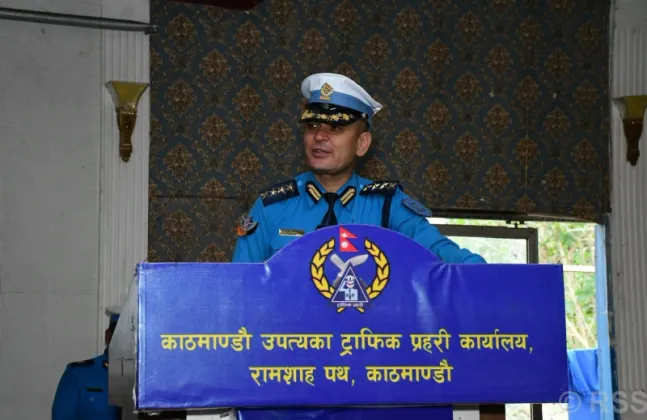
SSP Suresh Prasad Kafle, chief of the Kathmandu Valley Traffic Police Office, has warned that traffic police personnel involved in financial irregularities or in conduct that runs contrary to established police norms will not be shown any leniency. Kafle, a Senior Superintendent of Police, made the remark while addressing a program organized by the office on Sunday, and the office has separately confirmed that action will be taken against anyone found involved in such acts. The message, delivered from within the leadership of the force itself, underlines that financial discipline and professional conduct are being treated as non-negotiable standards for the traffic police in the valley.
A Direct Warning From the Top
The warning came from Kafle in his capacity as the head of the Kathmandu Valley Traffic Police Office. Speaking at the program organized by the office, he made it clear that personnel who become involved in financial irregularities will not be spared, and that the same firmness applies to any behavior that goes against the norms of the police institution.
The setting of the statement gives it added weight. Rather than coming from an external oversight body, the warning originated from the traffic police leadership and was addressed to its own personnel. As reported by RatoPati and Nagarik News, Kafle used the occasion to set out the office's position in unambiguous terms.
The key points of the message, as reported, can be summarized as follows:
- Personnel involved in financial irregularities will not receive any leniency.
- Conduct that goes against established police norms will also invite consequences.
- The office has committed to taking action against those found involved in such acts.
Action Promised Against the Guilty
Alongside the chief's warning, the Kathmandu Valley Traffic Police Office has stated that action will be taken against those found involved in financial irregularities or misconduct. The pairing of a public warning with a stated commitment to follow-through suggests the office intends the message to function as an operating principle for the force, not merely as rhetoric for a formal gathering.
For a law enforcement agency, a warning that is not backed by consequences risks losing its meaning. By announcing in advance that guilty personnel will face action, the office has effectively put both its members and the public on notice that internal wrongdoing, when detected, will be met with the department's response. The clarity of the statement also removes any ambiguity for personnel about where the leadership stands on questions of financial discipline and professional behavior.
Why Financial Integrity Matters for the Traffic Police
The traffic police occupy a distinctive position within Nepal Police. They are the most publicly visible arm of the force, deployed at intersections, along the valley's roads and at checkpoints, dealing directly with drivers, motorcycle riders, pedestrians and public transport operators every day. Their duties include enforcing traffic rules, managing congestion and handling violations, work that brings personnel into frequent contact with members of the public and with enforcement-related transactions.
Because of this constant public interface, questions of financial discipline carry particular weight for the traffic police. Any suggestion of irregularity within the ranks can quickly erode the trust that the force depends on to do its work, from securing cooperation at checkpoints to maintaining order on the valley's busy roads. Kafle's warning was directed at upholding that standard across the force, stressing that no member involved in wrongdoing should expect to be protected.
The statement, as carried in the reports, focused on the standard of conduct expected of personnel as a whole rather than announcing action against any specific individual.
Reinforcing Accountability and Public Confidence
With the warning now on record, attention will naturally turn to how the office follows through on its stated commitment to act against those found involved. The declaration that no leniency will be shown establishes a clear benchmark against which the force's internal handling of any future cases can be measured, both by its own personnel and by the public it serves.
For the Kathmandu Valley Traffic Police Office, the announcement is also an exercise in communicating expectations. By having its chief deliver the message at an in-house program, the office has signaled to its personnel that leadership is watching how they handle their responsibilities, and to the public that the force intends to hold itself accountable. The message serves as a reminder to members of the force that the standards announced publicly apply internally as well, and that financial integrity is a condition of service rather than an optional ideal.
Sustained vigilance will determine how far the warning goes in practice. If the office enforces the line it has drawn, the statement delivered on Sunday could serve as a reference point for the force's internal accountability. For the road users who interact with traffic police across the valley every day, the assurance that misconduct will not be tolerated is intended to strengthen confidence in the men and women managing Nepal's busiest roads.


