
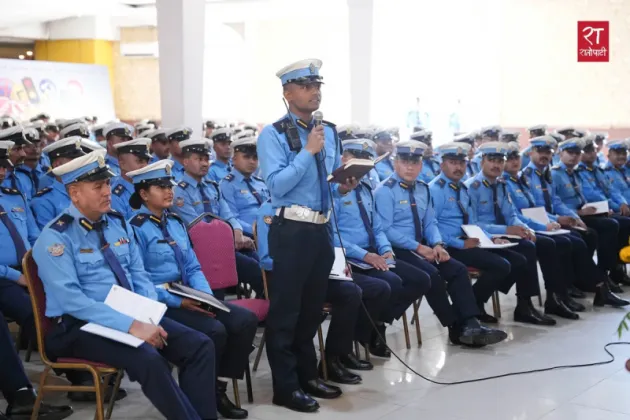
A traffic awareness interaction programme was held on Sunday at the Metropolitan Traffic Police Office, popularly known as Baggi Khana, in Ramshahpath, Kathmandu, with the aim of promoting road safety, ensuring effective compliance with traffic rules and supporting the development of a safer transport system in the capital. Ashish Gajurel, chairperson of the Infrastructure Development Committee, attended the event as the chief guest. The interaction, covered by RatoPati and Khabarhub, brought traffic authorities and a public representative to the same table to discuss the everyday safety of the capital's road users.
Objectives: Awareness, Compliance and a Safer System
According to reports, the programme was organised around three interconnected objectives, each addressing a different layer of the road safety challenge facing Kathmandu:
- Promoting road safety: fostering greater public understanding of safe behaviour on the road, whether among drivers, riders, passengers or pedestrians.
- Effective compliance with traffic rules: encouraging road users to observe the regulations that govern the capital's streets in their daily movement, so that the rules on paper translate into practice on the road.
- A safer transport system: supporting broader, long-term efforts to build a transport environment in which all users can move with confidence and security.
Taken together, these objectives reflect an understanding that road safety cannot be achieved through enforcement alone. Rules are only as effective as the willingness of people to follow them, and a transport system is only as safe as the awareness of those who use it. By framing the discussion around awareness, compliance and structural improvement at the same time, the programme presented road safety as a shared responsibility rather than a matter for the traffic police to handle single-handedly.
Chief Guest and the Choice of Venue
The presence of Gajurel as chief guest connected the discussion to the body he leads, the Infrastructure Development Committee, an institution whose work is closely tied to the planning and development of the capital's physical infrastructure. Roads, footpaths and transport facilities fall squarely within the committee's area of concern, and road safety is inseparable from how that infrastructure is designed, built and maintained.
His attendance at a traffic-focused interaction underscored the link between infrastructure development and traffic management. A city can draft and enforce the best possible traffic rules, but if the underlying infrastructure does not support safe movement, compliance becomes harder and hazards persist. Bringing the committee's leadership into a conversation hosted by the traffic police signalled an effort to view road safety from both angles at once.
Baggi Khana: Home of the Metropolitan Traffic Police
The setting of the event carried its own significance. Baggi Khana, located at Ramshahpath in Kathmandu, houses the Metropolitan Traffic Police Office, the institution at the forefront of managing and regulating vehicular movement across the capital. From enforcement of traffic rules to awareness campaigns aimed at the general public, the office sits at the centre of the daily effort to keep Kathmandu's roads functioning and its road users protected.
Hosting an awareness interaction at the traffic police headquarters itself highlighted the collaborative spirit the programme sought to promote. Rather than the traffic police simply issuing directives from behind their own walls, the format opened the office's doors to dialogue, positioning the institution as a partner in public education as well as an enforcing authority.
Road Safety in Focus: The Kathmandu Context
The interaction comes against the backdrop of persistent pressure on Kathmandu's road network. Like many rapidly growing cities, the capital contends with rising vehicle numbers, congested corridors and a daily mix of pedestrians, motorcycles, cars and larger vehicles sharing limited road space. In such an environment, the gap between written rules and actual road behaviour can carry serious consequences, which is precisely the gap that awareness programmes of this kind are designed to narrow.
Awareness-driven initiatives complement enforcement by addressing the human dimension of traffic management. When road users understand why rules exist and how their own choices affect others, compliance becomes a matter of habit and mutual respect rather than a response to penalties alone. Interaction programmes hosted by the traffic police are a familiar tool for cultivating that understanding, giving authorities and public representatives an occasion to exchange views on how safety can be improved on the ground.
Toward a Culture of Safer Roads
Sunday's interaction at Baggi Khana may be one programme among the many held across the capital each year, but its central message endures: safer roads depend on the combined efforts of those who plan and build the infrastructure, those who enforce the rules and the citizens who use the streets every day. By drawing the Infrastructure Development Committee and the Metropolitan Traffic Police Office into a single conversation, the event reinforced the idea that road safety is a shared civic project.
The emphasis the programme placed on awareness alongside compliance and system development points to a broadening approach in the capital, one that treats education and cooperation as essential companions to enforcement. For Kathmandu's road users, the hope generated by such interactions is straightforward: that discussions held inside the traffic police headquarters will eventually translate into safer, more orderly journeys on the streets outside.


