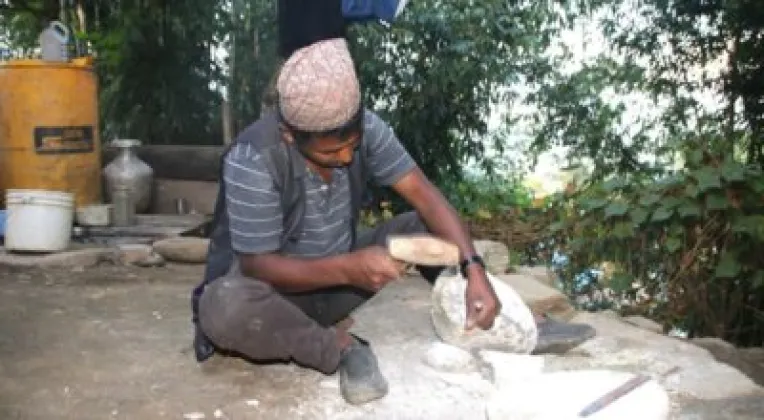
The sound of chisels striking stone, once as familiar in the villages of Panchthar as the crowing of roosters at dawn, is gradually fading into memory. The traditional occupation of carving stone grindstones, known locally as janto, is on the brink of extinction in the district as modern milling machines spread into villages and demand for hand-carved stones collapses. The Jogi community of Hilihang Rural Municipality-1, Dorumba, which produced grindstones for generations, is steadily abandoning the trade, and the handful of ageing artisans who remain have no successors in sight, according to recent reports published by Khabarhub, Rato Patal and Pradesh Khabar.
The Stone That Ground Nepal's Grain
For centuries, the janto has been an inseparable part of domestic life in Nepal's hills. The hand-operated implement, made of two circular stones fitted one above the other, was once found in virtually every rural household, grinding maize, millet, wheat, rice and spices long before electricity reached the villages. Every settlement needed someone who could carve and maintain these stones, and in Panchthar that role was filled almost entirely by the Jogi community.
The Jogi families of Hilihang Rural Municipality's wards 1 and 2 were traditionally engaged in this craft, supplying grindstones to surrounding villages and passing the skill down through generations. Making a janto was not casual work: an artisan had to know where to find suitable stone, how to split and shape it into perfectly matched circular slabs, and how to dress the grinding surface so that it would mill grain smoothly for years. That accumulated knowledge, carried by a small circle of families in Dorumba and neighbouring settlements, is now held by a shrinking and ageing group of practitioners.
When the Millwheel Stopped Turning
The reports describe a trade that has lost its market almost entirely within a single generation. The same villages that once relied on the Jogi artisans' stones now take their grain to electric mills, which grind flour in minutes without labour or waiting. As a result:
- Milling machines have spread into villages that previously depended on hand grinding
- Households no longer need a janto for their daily grinding of maize, millet and spices
- Demand for newly carved stones has fallen so sharply that the craft is no longer economically viable
- Young people from the artisan families have moved into other occupations altogether
For the Jogi carvers, each of these developments has stripped away a layer of their livelihood. What was once a steady village trade has become, in the space of a few decades, an occupation with virtually no customers.
One Man, Four Decades of Work, an Empty Craft
The human face of this decline is Man Kumar of Dorumba, who spent four decades of his life carving grindstones. Today he lives alone in the village, one of the last of a generation that made its living from the stone. His four decades span the craft's full arc: the years when Jogi artisans were kept busy by steady village demand, and the more recent years when machines took over and the orders stopped coming.
His solitude in Dorumba mirrors the wider situation of the community. As the work disappeared, so did the reason for the young to stay with it, leaving the older artisans without apprentices to whom they could pass on their skills. The reports present Man Kumar's circumstances as emblematic of a profession that is not merely declining but is approaching its final practitioners.
A Generation Looks Elsewhere
Perhaps the most decisive factor in the craft's decline is the departure of the young. The Jogi youth of Hilihang's wards 1 and 2, who in an earlier era would automatically have learned the chisel work from their fathers and uncles, are now choosing entirely different livelihoods. With no new entrants, the chain of transmission that kept the craft alive for generations has effectively been broken.
The consequences of that break are difficult to reverse. The skills involved in grindstone making, including selecting the right stone, shaping the two slabs so they fit and turn together, and finishing the grinding surface, exist only in the hands and memories of the remaining older artisans. Once that generation is gone, the practical knowledge of the trade in Panchthar goes with them, regardless of whether any future demand might emerge.
More Than an Occupation at Stake
What is disappearing in Dorumba is not simply a source of income but a piece of rural cultural heritage. The janto occupied a central place in village domestic life, and the people who made it formed a distinct occupational identity within the Jogi community of Hilihang. Its replacement by machines marks a broader transformation of hill villages, where electrification and changing lifestyles have quietly retired one traditional trade after another.
For now, the reports make clear, the craft survives only in pockets such as Dorumba, carried by artisans like Man Kumar who grew old with their tools. Unless something changes, the making of janto in Panchthar, an occupation that sustained the Jogi community for generations, is set to vanish with them, remembered only as the sound of chisels on stone that the villages no longer hear.