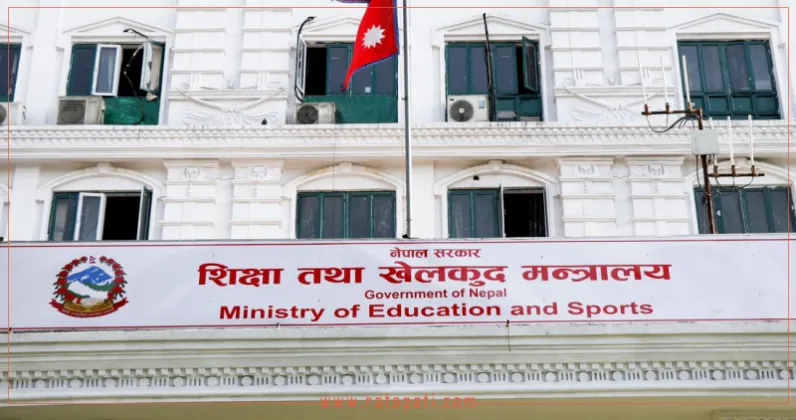
The Ministry of Education, Science and Technology has formed an investigation committee after details of nearly 200,000 students were found to be fake in the Integrated Educational Management Information System (IEMIS), the central database that maintains student records across Nepal's school education system. The ministry took the matter seriously after widespread duplication of student records was detected in the platform and ordered the investigation through a ministerial-level decision. The probe committee has been formed amid suspicions of corruption in the school education system, a development that puts the spotlight on how such a vast quantity of false data came to sit inside a national database.
Massive duplication detected in national database
The irregularity surfaced when the details of approximately 200,000 students in IEMIS turned out to be fake, according to a report by RatoPati. The problem was not a handful of clerical errors but widespread duplication of student records, meaning entries were repeated across the system to an extent that distorted the overall count of students in the country.
IEMIS is designed to function as the government's single, integrated platform for educational data, consolidating information about students from schools nationwide. The value of such a system rests entirely on the accuracy of what is entered into it. With records for roughly 200,000 students proving false, the credibility of the statistics the system produces, from total enrollment to the distribution of students between schools, is directly called into question.
The discovery has also raised the natural question of how long the duplication went unnoticed and at which points in the data chain the fake entries originated. Those are precisely the kinds of questions a formal investigation is expected to pursue.
Ministerial decision orders formal probe
The scale of the duplication prompted the ministry to elevate the matter beyond routine data correction. Through a ministerial-level decision, it ordered an investigation into the fake details, and a probe committee has now been constituted to carry that investigation forward.
Constituting a formal committee, rather than leaving the issue to the unit that manages the database, indicates that the ministry regards the discovery as an institutional problem rather than a simple technical fault to be quietly corrected. The panel's task will be to examine the fabricated details uncovered in IEMIS and establish the circumstances under which they entered the system.
The ministry's decision to act at this level also reflects the sensitivity of the matter. Student records feed directly into the administration of the school system, and irregularities on this scale have implications that extend well beyond the IT infrastructure in which they were found.
Corruption suspicions and the stakes of clean data
The committee's formation comes amid suspicions of corruption in the school education system. Those concerns suggest that the duplication may be connected to deeper irregularities rather than mere administrative oversight, although the exact nature of any wrongdoing remains for the investigation to establish.
The suspicions carry weight because student records are not abstract entries. They inform how the school system is planned, funded and evaluated. Reliable data on enrolled students is used to:
- plan education budgets and the allocation of resources across schools and districts
- monitor enrollment trends and the progression of students through the system
- evaluate the performance of schools and the education administration
- design and assess programs aimed at improving access and quality of education
When a large block of records cannot be trusted, each of those functions is compromised. Decisions made on the basis of duplicated or false numbers risk misdirecting attention and resources away from where they are genuinely needed, which is why the integrity of systems like IEMIS is treated as fundamental to education governance.
Accountability questions ahead
Details of the probe committee, including its composition, leadership and reporting timeline, have not yet been made public. Even so, its findings will be awaited closely within the ministry and across the school sector, as they are expected to clarify how such a large discrepancy accumulated and who bears responsibility for it.
For Nepal's education administration, the episode underlines how heavily policy now depends on centralized digital records, and how damaging it is when the data feeding those records goes unverified. The immediate questions before the government are stark: how did details of nearly 200,000 students come to be fake, why did the duplication spread so widely before it was detected, and what corrective measures will follow once the committee identifies its causes?
Until the committee reports, the ministry will be under pressure to demonstrate that the investigation is thorough, that those responsible for the fake entries are identified, and that the systems safeguarding Nepal's student data can once again be relied upon by schools, policymakers and the public.