
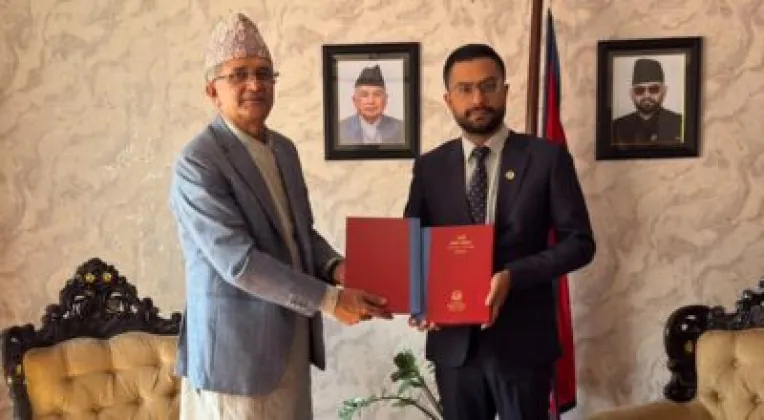
KATHMANDU - Teacher Service Commission (TSC) Chairperson Hari Prasad Lamsal on Tuesday submitted the commission's 18th annual report to Minister for Education and Sports Sasmit Pokharel at the Ministry of Education and Sports in Kathmandu. The handover marks the commission's formal yearly account of its work to the ministry that oversees Nepal's school education sector.
The report, prepared for 2026, presents a consolidated picture of what the commission did during the last fiscal year, the difficulties it encountered, and where it intends to take the teacher service in the years ahead. Details of the discussion between the chairperson and the minister were not immediately available, but the submission itself underscores the routine reporting relationship between Nepal's service commissions and the government ministries they work alongside.
What the 18th Annual Report Covers
According to the commission, the 18th annual report is built around three main components:
- Major activities of the year: A record of the commission's principal work during fiscal year 2026/27, the period the report reviews.
- Problems and challenges: An account of the obstacles the commission faced in carrying out its responsibilities during the year.
- Future plans: The commission's priorities and programmes for the coming years, setting out the direction it intends to follow in managing the teacher service.
Reports of this kind typically serve as the primary window through which the government examines the performance of commissions, since they bring together in one document the year's decisions, evaluations and outcomes. For the education ministry, the TSC's annual report is also a key input for policy planning, because teacher recruitment, licensing and promotion directly shape staffing in schools across the country.
The Commission's Role in Nepal's Education System
The Teacher Service Commission is the apex body responsible for managing Nepal's teacher service. Established under the Teacher Service Commission Act, it conducts the examinations and procedures through which teachers are licensed, appointed on a permanent basis and promoted within the school system, covering both community and institutional schools.
In practice, the commission's work sits at the centre of one of the most sensitive areas of education policy: who teaches in Nepal's classrooms, on what terms, and with what prospects for career progression. Because teacher appointments involve a large volume of positions and applicants nationwide, the commission's examinations and selection processes attract close public attention, and its performance is closely watched by teachers, their organisations, local governments and the wider education community.
The submission of an 18th annual report also reflects the institution's continuity. An annual reporting cycle of this length indicates that the commission has been presenting yearly accounts of its activities to the government for nearly two decades, in line with the practice followed by Nepal's other oversight and service bodies.
Why the Report Matters
Annual reports from bodies such as the TSC are more than a formality. They create a written record that policymakers can use to judge whether the machinery for managing the teaching workforce is functioning as intended, and they document challenges that might otherwise remain invisible outside the institution. For fiscal year 2026/27, the commission has presented the problems it faced during the year alongside its accomplishments, an approach that gives the ministry a more balanced basis for follow-up.
The report's forward-looking section is equally significant. By laying out its plans for the coming years, the commission signals its priorities to the ministry, to teachers and to the wider education sector, allowing other actors to align their own planning with the commission's direction. How the ministry responds to the report, and which of its identified challenges translate into corrective measures, will become clearer in the period ahead.
The submission was made at the Ministry of Education and Sports in Kathmandu, with Chairperson Lamsal presenting the report to Minister Pokharel. Further details of the report's findings were not included in the initial reporting. This story is based on reporting by Khabarhub.


