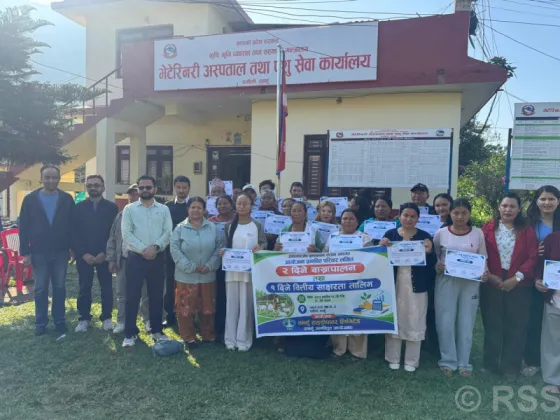
The Tanahun Hydropower Project has provided training in commercial goat farming and financial literacy to members of families affected by the project, in an effort to raise their incomes and create a basis for sustainable livelihoods. Twenty-two farmers from the project-affected Vyas and Bimad municipalities and Myagde and Rishing rural municipalities of Tanahun district took part in the commercial goat farming training, which was organised recently under the project's livelihood restoration plan. The Veterinary Hospital and Animal Services Office was involved in organising the programme, placing technical expertise in animal husbandry behind the sessions.
Part of a Broader Livelihood Restoration Plan
The training was carried out as part of the livelihood restoration plan that the Tanahun Hydropower Project is implementing for families affected by its works. Under the plan, the project is working to raise the income of affected households and to create a basis for livelihoods that can sustain those families over the long term. The goat farming and financial literacy training is one component of that wider effort.
The programme combined two complementary strands of instruction. The commercial goat farming training focused on equipping participants with the skills needed to raise goats as a business, while the financial literacy sessions were designed to help the same families handle money, plan their spending and make the most of what they earn. Together, the two components aim to raise household income and give affected family members a stable economic footing rather than a single, one-off benefit.
The key elements of the recently held programme can be summed up as follows:
- Training in commercial goat farming methods for affected family members
- Financial literacy training provided alongside the technical sessions
- Participation of 22 farmers from the project-affected area
- Organisation under the project's livelihood restoration plan
- Involvement of the Veterinary Hospital and Animal Services Office in running the programme
For the farmers who took part, the training offered a chance to learn methods that go beyond the traditional rearing of a few animals for household use. Commercial goat farming calls for a more systematic approach to animal care and management, and the participation of veterinary institutions in the programme underlined the technical nature of the shift being encouraged.
Farmers from Four Project-Affected Local Units
The 22 farmers who received the training came from four local units connected to the project area: Vyas Municipality and Bimad Municipality, along with Myagde and Rishing rural municipalities. All four are identified as areas affected by the Tanahun Hydropower Project, and the livelihood restoration plan is directed at the families living in these communities.
Extending the training across all four units meant that the benefits reached households in different parts of the affected area rather than being concentrated in a single settlement. The group of 22 participants therefore represents a cross-section of the farming households that the project is seeking to support as it works to restore livelihoods in the vicinity of its works.
Livelihood restoration has become a standard expectation for large infrastructure undertakings in Nepal, where projects such as hydropower schemes can take over land and disrupt the traditional occupations of nearby communities. Programmes of this kind are intended to give affected families new or improved income sources in place of the livelihoods they lose, so that the presence of a project does not leave the surrounding population worse off. The goat farming training fits squarely within that approach.
Veterinary Office Lends Technical Weight
A notable feature of the training was the involvement of the Veterinary Hospital and Animal Services Office, which took part in organising the programme. Its participation signals that the technical side of goat farming received due attention, since the office represents the veterinary and livestock services that farmers depend on for animal health and husbandry support.
Goat rearing is familiar to many rural households across Nepal, but running it as a commercial venture demands a different level of knowledge and care. Farmers moving into commercial production must attend to the health, feeding and overall management of their animals in a planned manner, and access to veterinary services becomes considerably more important once the scale of the enterprise grows. Linking the training to the Veterinary Hospital and Animal Services Office therefore offers participants a point of contact within the veterinary system as they put their new skills to work.
Financial Literacy to Make the Gains Last
Alongside the technical instruction, the financial literacy component addressed the other half of running a small enterprise. Skills in goat farming translate into lasting income only if households can manage that income well, setting money aside for lean periods, budgeting for the costs of the enterprise and gradually building on what they have. The financial literacy sessions were aimed at helping the participating farmers develop exactly that capacity.
The pairing of the two strands reflects the stated goal of the livelihood restoration plan: sustainable livelihoods rather than short-term relief. A farmer who learns to raise goats commercially but cannot manage the proceeds may struggle to keep the business going, while financial skills without a productive activity offer little to manage. By delivering both together, the project has sought to give affected families both a means of earning and the ability to make that earning endure.
Goats remain one of the most accessible livestock options for rural families, and commercial goat farming has been gaining ground across Nepal as a source of regular cash income. For the trained farmers of Vyas, Bimad, Myagde and Rishing, the programme has opened a path toward higher household income, one that the Tanahun Hydropower Project hopes will serve as a lasting basis for livelihoods in the communities affected by its works.