
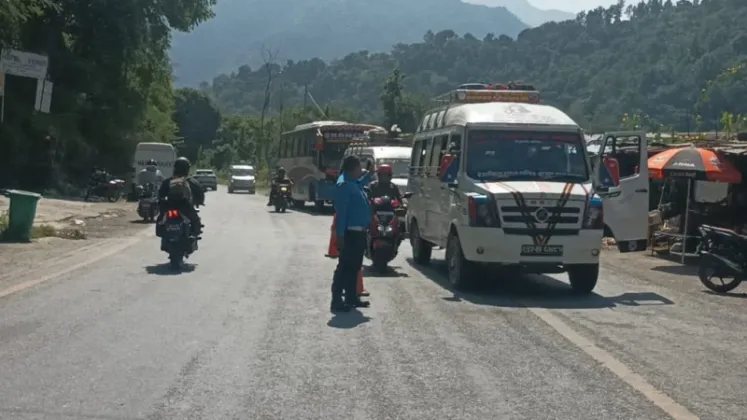
Traffic police in Syangja district collected more than Rs 2.8 million in fines by penalising vehicles that violated traffic rules during the first three months of the fiscal year 2026/27, the District Traffic Police Office Syangja has said. A total of 3,018 vehicles of various types were penalised between mid-July and mid-October, with the entire amount raised through action taken against traffic rule violations across the district.
Enforcement across the first quarter
The collection figures cover Shrawan, Bhadra and Asoj, the first three months of the Nepali fiscal year that begins in mid-July. During this period, the district traffic police office penalised 3,018 vehicles of different categories for breaching traffic rules, generating revenue of over Rs 2.8 million, which is roughly Rs 2.8 million (28 lakh) in the Nepali counting system.
The key figures from the three-month report are as follows:
- Revenue collected: over Rs 2.8 million
- Vehicles penalised: 3,018 of various types
- Period: mid-July to mid-October, the first quarter of fiscal year 2026/27
- District: Syangja, in Gandaki Province
- Source: District Traffic Police Office Syangja
The figures released by the office did not include a category-wise breakdown of the penalised vehicles, nor a month-by-month comparison of the collections. Taken as a whole, however, the numbers suggest that enforcement activity was continuous through the quarter, with the total working out to an average of roughly 33 vehicles penalised every day across the district's road network.
A quarter of monsoon roads and busy bazaars
The reporting period spans the tail of the monsoon season and the beginning of autumn, months when hill roads in districts like Syangja face persistent rain, slippery surfaces and occasional obstructions, while bazaar areas see steady movement of people and goods. Traffic police units are tasked with managing vehicle flow, checking documents and taking action against violations through this period, and the quarterly revenue figure reflects the volume of that enforcement work carried out between mid-July and mid-October.
How the fines add up
Traffic fines in Nepal are levied under the country's vehicle and transport management laws, which empower traffic police to take action against a wide range of offences. Enforcement drives at the district level commonly cover violations such as riding motorcycles without helmets, driving without a licence, drunk driving, overloading of passengers and goods, parking in restricted zones, and plying vehicles with expired registration papers or lapsed insurance. Penalties are typically collected on the spot or through the office, depending on the nature of the offence, and the amounts are deposited as government revenue.
The Rs 2.8 million collected in Syangja over the three months represents the cumulative total of such actions against the 3,018 vehicles penalised in the district. On average, the collection works out to a little over Rs 900 per penalised vehicle, though individual fine amounts vary widely depending on the violation and the type of vehicle involved.
Enforcement beyond revenue
While the headline figure is a revenue number, traffic police describe such collections as a byproduct of their primary mandate, which is to improve road discipline and reduce accidents. Nationwide, enforcement against helmetless riding, drunk driving and speeding is treated as a road-safety measure, with fines intended to deter repeat violations. District traffic offices across the country periodically publish their collection and action-taken figures, and the Syangja report is part of that regular stream of quarterly data on traffic enforcement outside the Kathmandu Valley.
Traffic policing in a hill district
Syangja lies in Gandaki Province and its district headquarters, Putalibazar, sits along the Siddhartha Highway, one of the major road corridors linking Pokhara with the Terai plains in the west. The highway carries a steady flow of public passenger vehicles, freight carriers and private vehicles through the district, while a network of rural and district roads connects the hill settlements to the bazaar centres. Managing traffic along this mix of highway and local roads is the core responsibility of the District Traffic Police Office Syangja, whose personnel conduct checks, regulate congestion at market areas and take action against violators.
The penalising of 3,018 vehicles in a single quarter indicates the scale of checking activity that the office sustained between mid-July and mid-October. As vehicle numbers across Nepal's hill districts continue to grow, district-level traffic offices have increasingly become the first line of enforcement on the highways and feeder roads that pass through their jurisdictions.
What the figures suggest
For readers, the report offers a snapshot of how active traffic enforcement was in Syangja during the opening quarter of the fiscal year: a vehicle was penalised on average every day of the period, and the fines collected crossed the Rs 2.8 million mark. The office has released the figures as quarterly enforcement data, and comparable updates are expected as the fiscal year progresses.
The report was first published by Online Khabar.


