
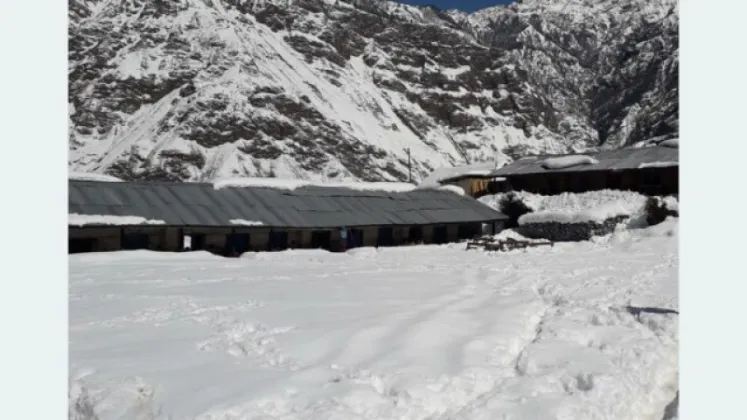
Six Indian tourists, among them two women, have gone missing in the snowbound high passes of Dolpa district after losing contact while trekking toward Shey Phoksundo Lake, with a local guide fearing the group may have been buried under the heavy snowfall that has swept the region. The tourists were travelling from Dolpo Buddha Rural Municipality toward the lake when contact was cut in the Numla Pass and Bagla Pass areas, between wards 4 and 8 of Shey Phoksundo Rural Municipality, according to reports by Khabarhub, Onlinekhabar and My Republica. A helicopter has been requested for the rescue operation as efforts to locate the missing group get under way.
A group of six lost on the high Dolpa trail
The missing group consists of six Indian nationals, two of them women. They had been making their way from Dolpo Buddha Rural Municipality toward Shey Phoksundo Lake, one of the most celebrated destinations in the Nepal Himalaya, when they stopped making contact. The area where they were last tracked lies in the Numla Pass and Bagla Pass sections, between wards 4 and 8 of Shey Phoksundo Rural Municipality, a stretch of trail that climbs far above the surrounding valleys and stands exposed to fast-changing mountain weather.
The crossing between Dolpo Buddha and the Phoksundo area is regarded as one of the most demanding sections of the Upper Dolpo trek. The Numla and Bagla passes sit at extreme altitudes, and even in favourable conditions trekkers face thin air, biting cold and long stretches of trail far from any settlement. When heavy snowfall strikes, those passes can be blotted out entirely, erasing the footpath and making navigation treacherous even for experienced guides.
Key details reported so far include:
- Six tourists missing: The group comprises six Indian visitors, including two women.
- Route: They were travelling from Dolpo Buddha Rural Municipality toward Shey Phoksundo Lake in Dolpa district.
- Last known location: The Numla Pass and Bagla Pass areas, between wards 4 and 8 of Shey Phoksundo Rural Municipality.
- Trigger: Heavy snowfall across the highlands, after which the group lost contact.
Burial fears and the push for an aerial rescue
Concern for the group is mounting. A local guide familiar with the terrain suspects the six may have been buried in the snow, a possibility that underscores how dangerous conditions on the passes have become since the snowfall. The warning has added urgency to the push to reach the area quickly, before the trail and any traces of the group are buried further.
In response, a helicopter has been requested for the rescue operation, a step that reflects both the remoteness of the location and the difficulty of moving rescue teams overland through fresh snow at high altitude. Aerial access is frequently the only practical way to reach the high passes around Shey Phoksundo in winter, but such flights depend heavily on the weather: strong winds, thick cloud or continuing snowfall can ground helicopters indefinitely, leaving rescuers waiting for a window of clear skies.
No confirmation on the whereabouts or condition of the tourists has yet been reported, and the search remains at an early stage.
Dolpa's high trails: a magnet for trekkers, a hazard in winter
The route the group was following runs through the heart of Dolpa, a vast and sparsely populated district in Karnali Province that hosts some of Nepal's most remote and spectacular landscapes. Dolpa is home to Shey Phoksundo National Park and to Shey Phoksundo Lake, an alpine lake renowned for its striking turquoise waters and widely regarded as the deepest lake in Nepal. Each year, trekkers from Nepal and abroad, including many Indian visitors, follow trails through the district that cross high passes, narrow ridges and treeless plateaus.
That beauty comes with serious risk. Winter brings heavy snowfall to the highlands, and the passes between Dolpo Buddha and the Phoksundo area are among the most exposed points on the route. At those altitudes, snow can accumulate rapidly, temperatures plunge far below freezing, and both movement and communication become extremely difficult. Trekkers caught in a storm can lose the trail, suffer frostbite or altitude illness, or become stranded until conditions ease.
The disappearance also highlights the broader challenge of rescue in Nepal's far-western highlands, where settlements are scattered, trails are long, and weather can close in with little warning. Even when aircraft are on standby, snow, cloud and wind often dictate when, and whether, a rescue flight can proceed.
Waiting for news from the passes
For now, the fate of the six tourists rests with the rescue operation taking shape in Dolpa. The requested helicopter is expected to play a central role in scanning the Numla and Bagla pass areas and, conditions permitting, landing searchers close to the group's last known location. Ground teams, where access allows, will face the same snow and cold that caught the trekkers.
Further details about the group, the timeline of their journey and the progress of the search have yet to be released. As efforts continue, the case stands as a stark reminder of how quickly conditions on Nepal's high Himalayan trails can turn from spectacular to perilous.


