
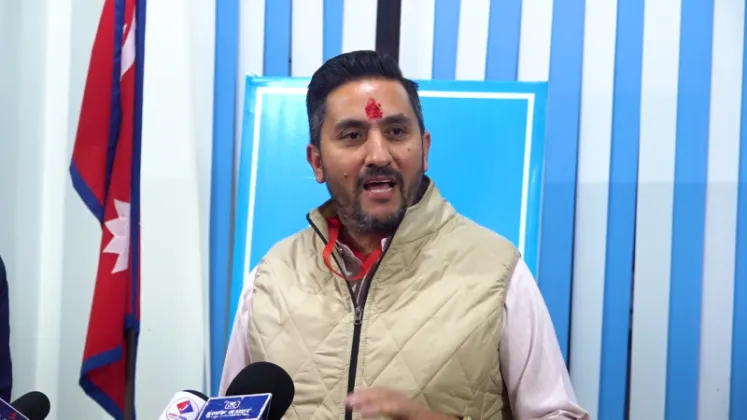
Kathmandu - The Rastriya Swatantra Party (RSP) has directed the government to respect press freedom and to investigate the detention of journalists, while also demanding action against those responsible for the arrests. The directives, reported by Nepali news outlets on October 31, 2026, place the party firmly on record as a defender of the media, and frame the detentions as an issue that requires an official response rather than a routine law-and-order matter.
The reports, carried by Thahakhabar and Nepal Views, indicate that the party's stance was communicated publicly, drawing attention to the treatment of journalists and to the obligations of the state in safeguarding their work.
A three-point directive to the government
According to the reports, the RSP's position on the issue rests on three principal demands directed at the government:
- Respect for press freedom: The government must honour the freedom of the press and ensure that journalists are able to carry out their work without fear of detention or intimidation.
- A probe into the detentions: The party has called for an investigation into the detention of journalists, so that the circumstances surrounding the arrests are properly established.
- Action against those responsible: Beyond the investigation itself, the RSP wants accountability, demanding that action be taken against those who detained the journalists.
Taken together, the three demands go beyond a simple expression of concern. By pairing a call to respect press freedom with specific demands for investigation and punishment, the party has sought to convert a general principle into concrete expectations for state conduct. The wording used in the reports - that the party "directed" the government - underscores the pressure the RSP is attempting to apply on the issue.
Why the detentions matter
The detention of journalists is widely regarded as one of the most serious forms of pressure that can be placed on a free press. When reporters are arrested, the effect extends beyond the individuals concerned: other journalists, aware that they too could face detention, may hesitate to pursue sensitive stories, ask difficult questions of authority, or report from the field on matters that those in power would prefer to keep quiet.
Press freedom organisations and media bodies in Nepal have long argued that the ability of journalists to work without obstruction is inseparable from the public's right to be informed. Any incident in which members of the press are taken into custody therefore tends to attract immediate scrutiny, both from within the media sector and from political parties seeking to hold the government of the day to account. The RSP's directive appears designed to channel that scrutiny into an official process - an investigation with named responsibility and, ultimately, consequences.
Press freedom as a constitutional commitment
Nepal's constitution guarantees freedom of expression and press freedom, and the country's media landscape is among the most vibrant in the region, spanning national dailies, television channels, FM radio stations and a fast-growing online news sector. Successive governments have publicly committed to protecting the press, and the treatment of journalists is frequently cited as a measure of the health of the country's democracy.
Against that backdrop, the RSP's directive reflects a broader expectation: that the state's conduct toward journalists should match the constitutional commitments made on paper. A party calling on the government to "respect press freedom" is effectively reminding it that the guarantee is not optional, and that detention of journalists sits uneasily with it. The demand for an investigation is consistent with that framing, since a credible probe is the standard mechanism for establishing whether rights were upheld in a given case.
A call for accountability
The most pointed element of the RSP's position is its demand for action against those responsible for detaining journalists. Demanding accountability in this way shifts the question from whether the detentions were unfortunate to whether they were justified - and, if not, who must answer for them.
- An investigation can establish the legal basis, or lack of one, for the detentions.
- Action against those responsible can serve as a deterrent against future arbitrary treatment of members of the press.
- A public accounting can reassure journalists, media houses and the wider public that the state takes its obligations seriously.
For the journalists concerned, the distinction matters in practical terms. A detention without due process disrupts reporting, exposes individuals to legal and financial strain, and can have a lasting chilling effect. A directive that demands both a probe and consequences is aimed precisely at ensuring that such costs are not borne silently by the press.
What the directive signals
The episode highlights the role that political parties can play in defending press freedom, particularly when they perceive that the government of the day has fallen short. By issuing a directive rather than a routine statement, the RSP has positioned itself as an active monitor of the government's conduct toward the media, and has signalled that it intends to keep the matter in public view until the investigation it seeks is carried out and responsibility is fixed.
For the government, the directive creates a clear set of expectations: respect for the press, a genuine investigation into the detentions, and action against those found responsible. Whether and how the government responds will now be watched closely by the media sector and by political observers, as the reports did not detail an immediate official reaction. What is already clear from the RSP's intervention is that the detentions of journalists have become a matter of political consequence, and that the party intends to hold the government to its stated commitment to press freedom.


