
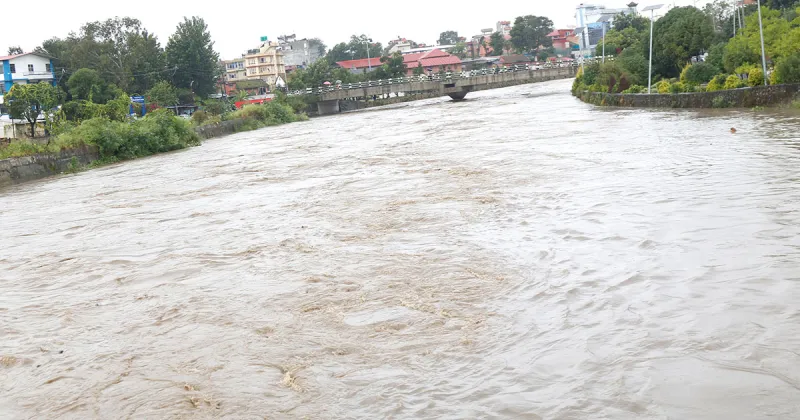
The Roshi and Panauti rivers in Kavrepalanchok district and the Bagmati and Kodku rivers in Lalitpur have crossed their respective warning levels, according to the Flood Forecasting Division, which has urged people living along the riverbanks to remain on high alert. The division said water levels at the affected stations climbed past the warning mark at 11:50 am on Friday, with the Kodku river breaching the threshold at Jharuwarasi. Officials cautioned that water levels in all four rivers are still rising and that the situation is being monitored closely.
Four rivers breach the cautionary mark
The Flood Forecasting Division's alert covers four separate waterways across two districts on the eastern and southern fringes of the Kathmandu Valley. In Kavrepalanchok, the Roshi and the Panauti rivers have both crossed the warning level, placing riverside settlements along their courses on notice. The Panauti river flows through the historic town of Panauti and surrounding villages, while the Roshi drains a broad section of the district before descending toward the hills to the east.
In Lalitpur, the alert applies to the Bagmati, the principal river of the Kathmandu Valley that runs along the boundary between Kathmandu and Lalitpur districts, and to the Kodku, a tributary that flows through the southern part of the district. The division specified that the Kodku crossed the warning mark at Jharuwarasi, a riverside settlement in southern Lalitpur, when the level was recorded at 11:50 am on Friday.
A warning-level breach means a river has risen past the threshold at which authorities begin alerting nearby communities, though it has not yet reached the danger level at which inundation of adjacent land is expected. The division's decision to issue a public alert for all four rivers at the same time indicates that flows are rising simultaneously across the two districts.
Residents urged to stay on high alert
The most significant element of the advisory is the division's warning that water levels are still climbing. Because the rivers have not yet peaked, officials have asked residents living along the riverbanks to remain on high alert rather than treat the crossing of the warning mark as a passing event. Areas that could be affected include homes, farmland and other property situated close to the channels, which are particularly vulnerable when rivers rise quickly.
The division's appeal was directed squarely at riverside communities, an emphasis that reflects how quickly conditions can deteriorate once a river passes its warning threshold. While the alert issued on Friday did not announce any further measures, standard practice during such advisories is for residents to take preparatory steps without waiting for conditions to worsen. These typically include:
- Moving family members, livestock and essential belongings to higher ground if the water continues to rise
- Avoiding riverbanks, bridges over swollen channels and activities such as fishing, grazing or washing near the water's edge
- Keeping children away from rivers and streams until levels recede
- Refraining from attempting to cross fast-flowing water on foot or by vehicle
- Following updates from the Flood Forecasting Division, local ward offices and security agencies deployed in the area
Residents have also been encouraged to stay in contact with neighbours and community networks so that vulnerable households, including the elderly and those living in low-lying areas, can be warned and assisted quickly if the rivers rise further.
What a warning level means
Nepal's river monitoring system uses a tiered structure of thresholds, and the distinction matters for communities along the affected rivers. The warning level is the earlier, cautionary stage: it signals that a river is rising toward its danger level and gives residents and officials time to prepare. The danger level, by contrast, marks the point at which water is likely to spill over the banks and inundate nearby settlements and farmland.
Crossing the warning level does not automatically mean flooding will occur, but it is a clear signal that the margin for complacency has narrowed. That is why the Flood Forecasting Division paired Friday's announcement with a direct warning that levels are still rising, rather than presenting the breach as a routine data point. Hydrological observations of this kind are drawn from river gauging stations, and the division identified Jharuwarasi as the point on the Kodku where the threshold was passed.
For the Bagmati in particular, an alert carries wide significance because the river gathers flows from across the Kathmandu Valley before passing through Lalitpur, meaning conditions along its course can affect a large number of settlements on both banks.
Monitoring continues
The Flood Forecasting Division said it is continuing to track the four rivers and that water levels had not receded as of the time of the alert. Communities in Kavrepalanchok and Lalitpur have been asked to keep monitoring official updates throughout the day, as further advisories may follow if the rivers approach their danger levels.
The alert was reported by Nagarik News and News of Nepal, both of which carried the division's call for vigilance in riverside areas. Residents along the Roshi, Panauti, Bagmati and Kodku are advised to treat Friday's warning level breach as an early signal and to act on official guidance as the situation develops.


