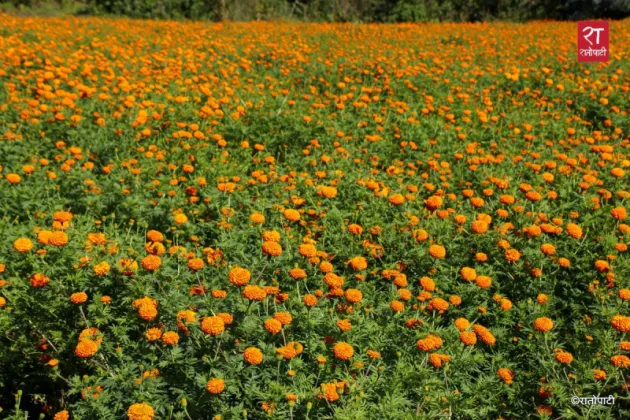
BANEPA: With the garlands and glow of Tihar drawing near, the marigold fields of Basdol in Banepa Municipality-12, Kavre, are at their most vibrant, and Madhav Ghimire stands at the centre of the season's rush. The 59-year-old farmer, who spent 17 years working abroad before returning to his home village, has watched his marigold crop come into full bloom just as demand for the festival flower begins to climb. Nine years after taking up flower farming on just five ropani of land, Ghimire has expanded his cultivation to 14 ropani and is now busy tending his plants and preparing them for sale ahead of the festival.
Seventeen years abroad, a new beginning at home
Ghimire's journey into flower farming followed a long detour through foreign employment. For 17 years he lived and worked outside Nepal, part of the generation of Nepali workers who spend their prime years abroad before returning home. When he finally came back to Basdol, he put his energy not into searching for another contract overseas, but into the soil beneath his own feet.
Nine years ago, he planted his first flowers on five ropani of land, a modest plot by commercial standards. The experiment worked. Season after season he expanded, and his farm now spreads across 14 ropani, more than 7,000 square metres of blooming marigolds on the hills of Kavre. The steady growth of the plot reflects a farmer who learned the trade late in life, but learned it well.
For a man of 59, the routine is physically demanding. As Tihar approaches, Ghimire spends his days among the rows of plants, tending the blooms that will soon leave his farm in garlands and bunches. The work is the payoff of a decision made nearly a decade ago: to build a livelihood in the village he had left as a younger man, rather than seek his fortune abroad again.
The flower that defines Tihar
Marigolds, known in Nepali as sayapatri, are the signature flower of Tihar, the five-day festival of lights. Their bright orange and yellow blooms appear everywhere during the festival week, and demand from devotees, households and traders rises sharply in the days leading up to it.
A garland for every ritual
- Garlands of marigold are offered to deities, most prominently to the goddess Laxmi during Laxmi Puja, the night when homes and shops are lit with oil lamps and candles.
- Brothers receive marigold garlands from their sisters during Bhai Tika, the festival's closing day and one of its most cherished traditions.
- Crows, dogs and cows honoured on the earlier days of the festival are also adorned with flowers, while doorways and windows across the country are decorated with fresh garlands.
That combination of religious duty and festive decoration is what makes Tihar the single most important season of the year for marigold growers. Flowers that reach the market at the right moment, fresh and fully open, are quickly bought up for garlands and offerings, while mistimed blooms can miss the peak altogether. For growers like Ghimire, the festival is not merely a cultural moment but the commercial high point around which the entire year's planting is built.
A race against the calendar
The final days before Tihar are the busiest of Ghimire's farming year. With demand climbing, he is tending the plants and making sure the flowers are in prime condition as the sales window opens. Timing is critical: marigolds must open in the stretch between Laxmi Puja and Bhai Tika, when demand is at its height, and growers plan their sowing and planting months in advance so that the fields turn orange and yellow precisely when the festival does.
This year the timing appears to have worked in his favour. According to reports by Ratopati and Khabarhub, the flowers on his expanded 14-ropani farm have bloomed as the festival approaches, and Ghimire is now focused on preparing the harvest for sale.
A second career rooted at home
Beyond the blooms themselves, Ghimire's story carries a message that resonates in a country where many workers return from foreign employment with savings, skills and a search for what comes next. His nine years of flower farming show one route that homecoming can take: rather than chasing work abroad again, he reinvested in his own village, expanded his farm from five ropani to 14, and built a business tied to one of Nepal's most beloved festivals.
His experience also points to the wider potential of commercial flower farming in districts like Kavre, whose location near the Kathmandu Valley places growers close to the urban markets where festival demand is strongest. What began as a returned migrant's undertaking on a small plot has grown into a flourishing seasonal enterprise.
For now, though, Ghimire's attention is fixed on the plants in front of him. The garlands of Tihar are woven from flowers like his, tended by hands that know both the hardship of working far from home and the satisfaction of watching a village field turn gold. As the festival lights go up across the country, his marigolds will be part of the celebration, blooming proof that sometimes the richest harvest is the one grown back home.