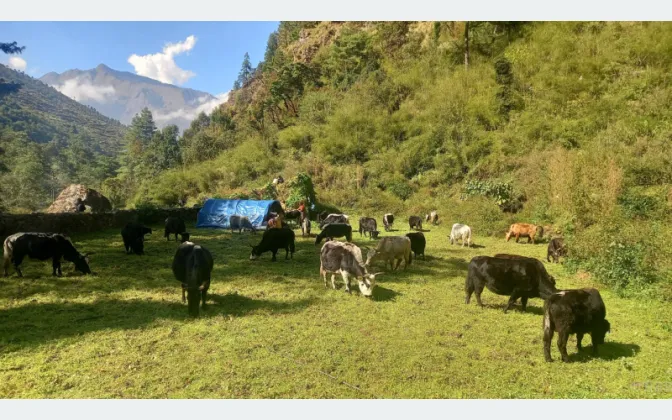
Pasang Sherpa, a 34-year-old resident of Nagung in Gosainkunda Rural Municipality-6, Rasuwa, has shown that a secure future can be built without leaving home, returning after three years of work in Malaysia to establish yak farming as a commercial venture in his own village. Having found that wages abroad did not match his expectations, Sherpa turned to his family's ancestral occupation and restructured it as a business rather than a subsistence activity. His story, reported by Nepali media including RatoPati and Gorkhapatra Online, is being presented as an example of how hard work in one's own village can bring success at a time when growing numbers of young Nepalis are heading overseas for employment.
Three Years in Malaysia, and a Turning Point
Sherpa's path initially followed the route taken by countless young people from Nepal's hill and mountain districts. Like many of his generation, he left Nagung for foreign employment and spent three years working in Malaysia, one of the most common destinations for Nepali migrant workers.
The experience, however, did not deliver what he had hoped. According to reports, he was unable to earn as much as he had expected despite years of toil abroad. Rather than viewing the disappointment as a defeat, Sherpa treated it as a turning point. Instead of extending his stay or seeking work in another country, he made the decision to return to Rasuwa and invest his energy in the resources already available in his own village.
From Ancestral Occupation to Commercial Venture
What distinguishes Sherpa's case is not simply that he returned home, but what he chose to do after arriving. Yak herding has been practised in his family for generations, but like much traditional livestock rearing in Nepal's highlands, it had long been associated with subsistence living rather than enterprise. Sherpa resolved to change that approach, taking up the occupation of his ancestors with the mindset of a commercial farmer.
His journey can be summed up in a few steps:
- Spending three years in Malaysia, where earnings fell short of expectations
- Deciding to return to Nagung rather than continue in foreign employment
- Reviving yak farming, the occupation inherited from his forefathers
- Running it as a commercial venture instead of a small-scale household activity
By applying the discipline and ambition he carried back from abroad to a livelihood rooted in his own village, Sherpa has demonstrated how traditional skills and modern enterprise can be combined. His experience suggests that the problem for many returned migrants is not a lack of opportunity at home, but a lack of recognition of the value of what their villages already offer.
The Natural Advantage of Rasuwa's High Pastures
The choice of yak farming is closely tied to the geography of Gosainkunda Rural Municipality. Rasuwa lies in the high Himalayan region of Bagmati Province, and the area around Nagung sits at an altitude where cold-climate livestock thrive. Yaks are uniquely adapted to such conditions, grazing on high pastures where other cattle cannot survive, and they have sustained mountain communities for centuries.
The surrounding landscape adds further significance. The rural municipality takes its name from the sacred alpine lake of Gosainkunda, a major pilgrimage site that also draws visitors to the region. In such terrain, yak herding is not merely a cultural tradition but an economically logical use of land that offers little scope for conventional farming. Sherpa's decision to build his venture on this foundation reflects a practical reading of his village's natural endowments.
A Message for a Generation Heading Abroad
Sherpa's story has resonated because it speaks to one of Nepal's most pressing social trends. Large numbers of young people continue to leave the country for foreign employment each year, drawn by the prospect of higher wages but often facing difficult working conditions and uncertain savings. The departure of productive youth has left many villages depopulated and farmland and pastures underused.
Against this backdrop, media outlets such as Khabarhub have highlighted Sherpa's case as evidence that the opposite path is also possible. His experience carries a clear message for Nepali youth weighing the option of going abroad: with commitment and hard work, meaningful income and self-reliance can be achieved within one's own village. For returned migrants in particular, who bring back savings, skills and a firsthand understanding of the true cost of life away from home, livestock and agriculture can offer a credible route to self-employment.
Success Rooted in the Village
At 34, Sherpa represents a generation often described as Nepal's migrant workforce, yet his future now lies in the high pastures above Nagung. By transforming a inherited occupation into a commercial success, he has shown that foreign employment is not the only road to prosperity for young Nepalis. His village, his family's traditional knowledge and his own willingness to work hard proved to be sufficient ingredients for a sustainable livelihood. For the many communities across Rasuwa and Nepal's other mountain districts watching their youth depart, his example offers a persuasive reminder that opportunity can grow as readily at home as it is promised abroad.