
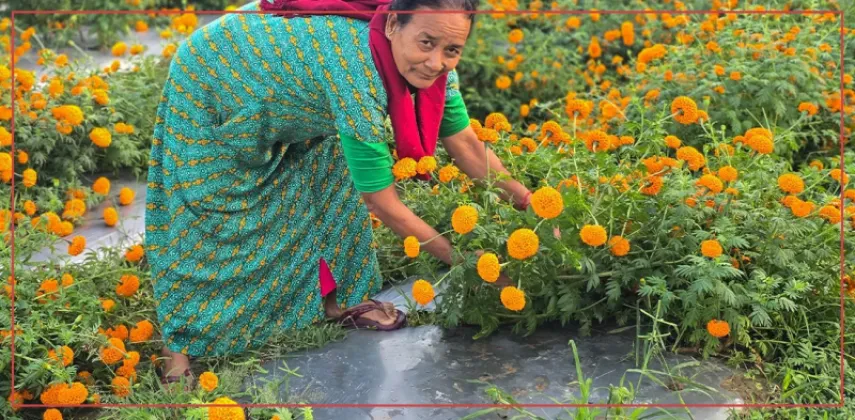
Farmers in Siraha are counting their losses after two days of continuous rain damaged flower farming at the worst possible time, just ahead of the Tihar and Chhath festivals, when demand for flowers reaches its yearly peak. Growers across the district, including in Golbazar Municipality, had spent months preparing their crops for harvest and sale during the festive season, only to see that hard work harmed by the downpour, leaving many of them deeply disappointed as two of Nepal's biggest celebrations draw near.
Two Days of Rain Undo Months of Work
The rain fell without a break for two consecutive days, striking precisely when farmers were getting ready to pick their blooms and bring them to market. According to reports by RatoPati and Arthasarokar, the affected growers had timed their cultivation so that their flowers would be ready for harvest during the festive season, a window that represents the most important sales period of the year for many of them.
Flowers are a delicate crop at the best of times. They must be picked at exactly the right stage, handled carefully and sold quickly, since unsold blooms wilt within days. When heavy rain strikes a standing flower crop, the damage can be immediate: petals bruise, stems bend and an entire harvest can be rendered unsellable. For Siraha's growers, the two-day downpour therefore threatened not just the current crop but the income of an entire season.
The immediate impact on the farming community includes:
- Damage to standing flower crops after two days of continuous rain.
- The loss of a harvest that had been planned specifically for the Tihar and Chhath festive market.
- The waste of months of labor, care and investment put into cultivation.
- Widespread disappointment among growers who had counted on festive season sales.
Why the Festive Window Matters So Much
Tihar and Chhath are among the most widely celebrated festivals in Madhesh Province and across Nepal. Households decorate their homes, make floral offerings during worship and use garlands as part of the celebrations, which makes the days around the festivals the busiest and most profitable stretch of the year for flower farmers.
Growers plan their planting calendars months in advance with exactly this window in mind, working backward from the festival dates so that their crops mature at the right moment. When rain destroys a crop only days before the celebrations begin, there is no opportunity to replant and recover within the same season. The selling period is effectively lost, and with it the earnings that many farming households depend on.
That is why the disappointment in Siraha is about more than damaged plants. It reflects the collapse of a carefully planned yearly cycle, in which months of steady work in the fields were meant to pay off during a short but crucial stretch of the market calendar.
A Veteran Grower Among the Affected
Among those hit is Manu Syangdan, a flower farmer from Golbazar Municipality-3. According to the reports, Syangdan said he has been cultivating flowers for the past 15 to 20 years. Two decades in the trade means he has seen many festive seasons come and go, and that his farm is not a recent experiment but an established livelihood built up over years of experience.
For a grower with that length of involvement, the timing of the damage is particularly painful. Flower farming demands attention through the entire cycle, from preparing the land and planting through watering, weeding and protecting the plants, all of it aimed at a brief and decisive selling period. When weather disrupts that period, there is no second chance before the festivals pass. Syangdan's disappointment captures the mood of growers across the area who watched the rain fall on crops that were ready or nearly ready for harvest.
What Comes Next for Siraha's Farmers
The immediate concern for the affected farmers is assessing how much of the crop can still be salvaged. Flowers that survived the rain may still be harvested and sold if conditions improve, but their quality and shelf life may be reduced, and buyers during the festival period tend to be selective about the condition of the blooms they purchase for worship and decoration.
The reports did not immediately provide a complete estimate of the financial losses caused by the rain, and it remains to be seen whether the growers will receive any support to help absorb the blow. What is clear is that the damage has arrived at the most consequential moment of the flower-farming calendar, with Tihar and Chhath only days away and markets preparing for their heaviest flower demand of the year.
The episode also underlines how exposed flower farming is to the weather. Unlike some crops, flowers offer little flexibility once they reach maturity: they must be harvested and sold within a narrow window, and a single spell of bad weather can wipe out months of work. For the farmers of Siraha, two days of rain have turned what should have been the busiest and most rewarding stretch of the year into a season of loss and uncertainty.


