
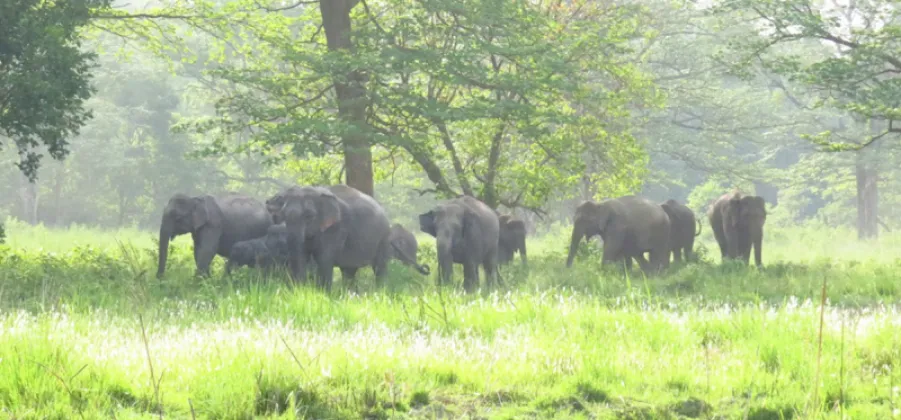
The process of fitting radio collars on wild elephants has begun in the buffer zone of Shuklaphanta National Park in Kanchanpur, as authorities move to address the long-running conflict between elephants and the communities living along the park's edge. The Department of National Parks and Wildlife Conservation has instructed the Shuklaphanta National Park Office to take the radio collar installation forward, according to reports published by Nagarik News, Ratopati and Gorkhapatra Online.
The decision responds to a persistent problem: wild elephants from the park have long been straying into nearby settlements, where they have caused damage to lives, property and crops, leaving buffer zone residents to count their losses repeatedly.
A conflict that has festered for years
For villages scattered across the buffer zone of Shuklaphanta National Park, the approach of a wild elephant herd is a source of constant anxiety. According to the reports, elephants have repeatedly entered human settlements in the area, raiding fields, damaging houses and other property, and in the gravest cases threatening human lives.
The burden falls hardest on farming families, for whom a single night of crop raiding can destroy a harvest that took an entire season to grow. Beyond the immediate losses, the regular presence of elephants disrupts daily life. Residents are forced to remain alert after dark, guard their fields and abandon routines that people living away from wildlife habitat take for granted.
It is against this backdrop that the Department of National Parks and Wildlife Conservation, the government body that oversees Nepal's protected areas, has directed the park office to move ahead with collaring the elephants.
What the radio collars are expected to do
Radio collars are tracking devices fitted around an elephant's neck that transmit the animal's location, allowing technicians and park staff to follow its movements over time. For a park such as Shuklaphanta, where elephants move between the forest core and the surrounding buffer zone, that information can transform how conflict is managed. Rather than reacting only after elephants have already entered a village, authorities can monitor where the animals are heading and act in advance.
Among the practical benefits the collars are expected to deliver:
- Real-time monitoring of elephant movements inside the park and toward the settlements
- Early warnings to buffer zone communities when herds draw near, giving families time to move to safety
- Better data on habitat use and movement routes, which can inform long-term planning by the park
- Faster deployment of response teams to drive elephants back toward the forest before damage occurs
A technically demanding operation
Collaring a wild elephant is not a routine task. The animal must first be located and tranquilized, the collar fitted, and the elephant revived and monitored, work that is typically carried out by trained veterinary and technical teams. Once in place, the collar becomes a continuous link between the elephant and the park's monitoring system, relaying location data that staff can use to track the herd's whereabouts day and night.
The department's directive sets the process in motion
The instruction from the Department of National Parks and Wildlife Conservation formally puts the administrative machinery behind the collaring effort. With the directive issued, responsibility for carrying out the installation now rests with the Shuklaphanta National Park Office, which is to advance the process in the buffer zone.
The initiative also reflects the practical reality of conservation in the Terai, where protected areas and human settlements sit side by side and the movements of wildlife inevitably cross paths with farmland. Nepal's buffer zones are designated areas around national parks where local communities live and depend on forest and land resources, a framework that deliberately keeps people and wildlife in close proximity and makes managing their interaction a central task of park management.
Shuklaphanta and the challenge of coexistence
Shuklaphanta National Park, in Nepal's far-western district of Kanchanpur, is one of the country's important habitats for large mammals, and wild elephants are among its most conspicuous residents. The settlements in its buffer zone depend heavily on agriculture, which places village fields in close proximity to elephant habitat and makes encounters difficult to avoid entirely.
For the park's managers, the challenge is to protect both the wildlife within its boundaries and the people who live around it. The collaring programme is designed to serve both goals. By knowing where elephants are and where they are heading, authorities can warn communities in time and intervene before confrontations turn destructive, reducing losses for villagers while limiting the chances of dangerous encounters for the animals themselves.
Much now depends on how quickly and effectively the park office implements the department's directive. For buffer zone residents in Kanchanpur who have lived with the threat of elephant incursions for years, the prospect of a collared herd that can be tracked and anticipated would mark a meaningful shift from reacting to damage after it occurs to preventing it before it starts.


