
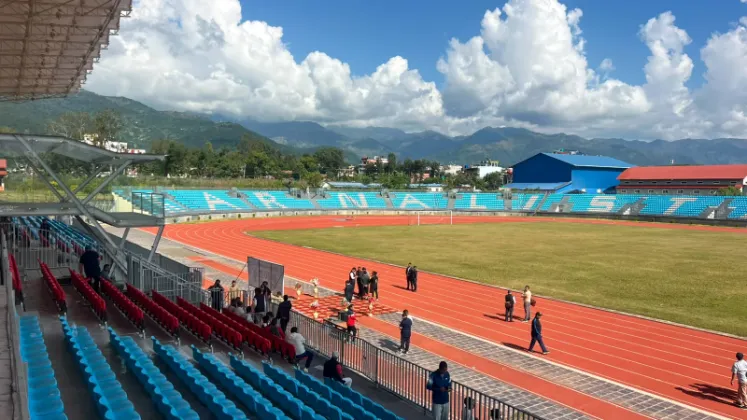
The provincial stadium built in Birendranagar, the capital of Karnali Province, has become a new symbol of the province's sports pride and identity, according to reports in Nepali media. Constructed with modern sports infrastructure in the Surkhet valley, the facility has established Karnali as an important destination for national sports, a development that local outlets describe as a matter of pride for the region's sports sector. As reported by Pradesh Khabar and Nepal Views, the stadium represents both a physical landmark for Birendranagar and a broader statement about Karnali's growing place on Nepal's sporting map.
A New Landmark in Karnali's Capital
The stadium stands in Birendranagar, the administrative capital of Karnali Province, which occupies the Surkhet valley in Nepal's mid-western hills. For residents of the province, the facility's arrival in the capital carries a meaning that extends well beyond athletics. The reports consistently describe it as a new symbol of the province's pride and identity, a framing that reflects how significant modern infrastructure of this scale is for a region that has often stood at the edge of Nepal's national development story.
Karnali, Nepal's largest province by area, has long contended with difficult geography and comparatively limited infrastructure, and large public projects in the province tend to draw outsized attention for that reason. A provincial stadium built to modern standards in Birendranagar therefore functions as more than a venue. It is a visible assertion, in concrete and steel, that the province can build and sustain facilities comparable to those found elsewhere in the country.
Modern Infrastructure Puts Karnali on the National Sports Map
The defining feature of the new stadium, according to the reports, is its modern sports infrastructure. It is this quality, the coverage suggests, that has allowed the facility to accomplish what it has: drawing national-level sporting attention to Surkhet. The reports state plainly that the stadium has established Karnali as an important destination for national sports, positioning the province as a credible setting for competitions that would once have been staged elsewhere.
From Sending Athletes Out to Hosting Them In
The implications of that shift are practical as well as symbolic. A modern facility in the provincial capital means athletes from Karnali can train and compete in serious conditions without leaving the province. And when national events are staged in Birendranagar, the province hosts rather than sends, a reversal of the pattern implied by its previous absence from the circuit of major Nepali sporting venues. Each event that comes to Surkhet brings players, officials and spectators into the province, reinforcing the destination status that the reports highlight.
A Matter of Pride for the Region
Both reports frame the stadium in emotional terms as much as practical ones. The coverage describes the facility as a matter of pride for the region's sports sector, and that idea of pride runs through the two accounts. In a province where sporting talent has often had to seek proper infrastructure elsewhere, the presence of a modern stadium in the provincial capital is presented as a source of collective satisfaction for athletes, sports officials and residents alike.
The pride also carries an identity dimension. For Karnali, whose image in the national imagination has been shaped more by hardship than by achievement, the stadium offers a different kind of story to tell about the province. The language of pride and identity used in the reports suggests the facility is being received locally as a marker that the province's sports sector is finally being taken seriously, both by the provincial administration that built it and by the national sporting community that it now hopes to serve.
Expectations for the Facility's Future
With the stadium now established as a destination for national sports, the obvious next question is how the facility will be used going forward. The available reports do not detail a calendar of upcoming competitions, but they leave little ambiguity about the direction of travel: Karnali is being positioned to host, and the modern infrastructure is the factor that makes that possible. Regular use of the venue for national-level events would consolidate the status that the coverage describes and deepen the stadium's role in the province's sporting life.
For now, the significance of the project is best captured in the reports' own framing. A provincial capital in the hills of mid-western Nepal has acquired a modern sports facility, and with it a new emblem of provincial pride and identity. Whether the venue grows into a lasting engine for sport across Karnali will depend on the competitions, athletes and programs that follow. But as the reporting from Pradesh Khabar and Nepal Views makes clear, the province's sports sector already counts the Birendranagar stadium as an achievement in its own right, and one that has changed how Karnali sees itself in the country's sporting picture.


