
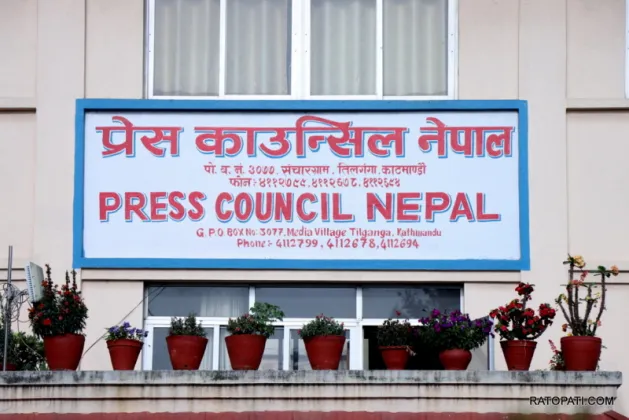
Press Council Nepal has expressed serious objection to the detention of journalists by plainclothes police officers who entered the newsrooms of media houses in Kathmandu on Friday, in an operation reportedly carried out without arrest warrants or permission from the courts. In a statement issued by the Council's senior administrative officer and spokesperson Deepak Khanal, the press regulator said the detentions raise grave questions about press freedom and the professional security of journalists. The Council has demanded that the authorities make public the legal basis for the action and release anyone found to have been held without legal grounds.
Press Council demands legal basis be made public
The statement, issued through spokesperson Deepak Khanal, placed press freedom and the professional security of journalists at the centre of its objection. According to the Council, the entry of police into newsrooms and the detention of journalists from their workplaces is not an ordinary law-enforcement matter, and the way the operation was conducted gives rise to serious questions that must be answered. As reported by RatoPati, the Council framed its position around two core demands:
- The legal basis on which plainclothes police entered media houses and detained journalists should be made public.
- Those held without legal grounds should be released.
By demanding disclosure of the legal basis, the Council underlined that the grounds for the operation were not publicly known at the time it issued its objection. The statement positions the detentions as a matter that concerns not only the journalists taken from the newsrooms, but the operating environment of the media in general, since the action took place inside the offices of media outlets in the capital.
After-hours operation ahead of public holidays
The incident occurred after office hours on Friday and immediately ahead of two consecutive public holidays, a timing that has been highlighted in coverage of the operation. The sequence means that the detentions became known publicly at a moment when government offices and institutions were heading into an extended break, complicating the ability of press bodies and media houses to respond while the operation itself was still unfolding.
According to a report by Nagarik News, the police action involved a search for a news source, with officers entering newsrooms in the capital. The offices of Nepal Press and Naya Patrika were among the media houses affected by the raids, as reflected in the reactions that followed. The reports also note that the police were in plainclothes and that no arrest warrants or court permission were shown, according to initial accounts of the incident.
"State terror": press union demands immediate halt
The sharpest reaction came from the Nepal Press Union, which condemned the detention of journalists from the newsrooms in strong terms, describing the action as "state terror." In a statement issued under acting president Dipak Acharya and general secretary Dahal, the union demanded that the action be stopped immediately. The union's statement puts the incident in the category of state action against the press rather than a routine policing matter, and links it directly to the safety and freedom of journalists to work from their own offices.
ANNFSU protests raids on Nepal Press and Naya Patrika
Criticism of the operation has also come from outside the press fraternity. The All Nepal National Free Students' Union (ANNFSU), the student organisation aligned with the UML, protested the raids on the offices of Nepal Press and Naya Patrika, as reported by Khabarhub. The protest by the UML-affiliated student body indicates that concern over the raids has extended beyond press freedom organisations, adding a political dimension to the controversy over the police action.
Prime Minister's Office clarifies it was not involved
Amid the questions raised by the detentions, the Prime Minister's Office has issued a clarification stating that it was not involved in the case, according to Nagarik News. The clarification addresses the question of involvement at the level of the Prime Minister's Office, while the central demands raised by the Press Council and press organisations remain outstanding: the disclosure of the legal basis for the operation and the release of those held without legal grounds.
The combination of responses, from the Council's formal objection and the Nepal Press Union's "state terror" characterisation to the ANNFSU protest and the Prime Minister's Office clarification, has kept the focus on two unresolved points: under what legal authority plainclothes police entered the newsrooms on Friday, and on what grounds the detained journalists continue to be held. Until those questions are answered publicly, they remain the core of the controversy surrounding the operation against media houses in Kathmandu.


