
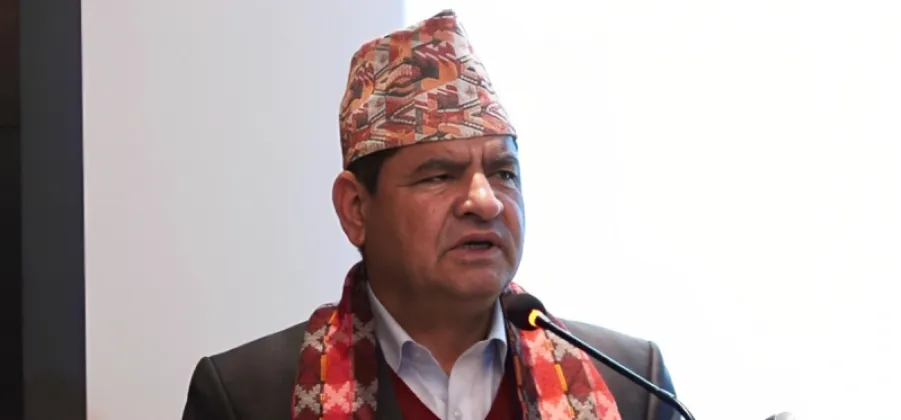
Nepali Communist Party spokesperson Prakash Jwala has said the unity forged between the Nepali Communist Party and the Nepal Communist Party was carried out with the central aim of ending the divisions and fragmentation that have long weakened Nepal's communist movement. Speaking at a unity declaration programme held at Parisdanda in Kathmandu, Jwala said the two parties moved ahead with the merger only after arriving at common ground on questions of ideology, principles, programmes, policy and organisation. He added that the unity is intended to build the basis for national sovereignty, democratic rights and socialism, framing the declaration as both an organisational milestone and an ideological course correction for the fractured left.
Merger followed agreement on core questions
Addressing the gathering at the unity declaration programme, Jwala was at pains to present the unification not as an improvised arrangement but as the outcome of agreement across the fundamental areas on which any communist party is built. According to his remarks reported by Nagarik News, the merger was advanced after the two parties reached common ground on:
- Ideology
- Principles
- Programmes
- Policy
- Organisational questions
By listing these areas of convergence, the spokesperson appeared to answer a criticism that has followed past unification efforts in Nepal's left politics: that mergers have too often been driven by circumstance rather than shared conviction. In his telling, the Nepali Communist Party and the Nepal Communist Party settled their differences on the basics first, and only then proceeded to declare unity. That sequencing matters for a party's future, since disputes over ideology, programme or organisational structure are precisely the fault lines along which communist parties in Nepal have historically split apart again.
Jwala's framing at Parisdanda thus positioned the declaration as the product of sustained negotiation and internal settlement, rather than a tactical adjustment made for short-term political advantage.
A warning against division in practice
The spokesperson also delivered a pointed message about the gap between rhetoric and conduct. As covered by Nepal Press, Jwala said that singing songs of unity while dividing in practice has weakened the communist movement.
The remark served as both a diagnosis and a caution. In his assessment, the movement's weakness does not lie in its ideals or its programme, but in the repeated behaviour of communist forces that proclaimed togetherness while working at cross purposes on the ground. Declarations of unity, he suggested, count for little if factional conduct continues beneath the surface.
By voicing that warning at the very event marking the union of the two parties, Jwala effectively set the standard by which the new arrangement should be judged. The implication of his message was clear: the credibility of the unity will be measured not by what is said on stage, but by whether leaders and cadres refrain from the dividing-in-practice behaviour that, in his words, has drained strength from the movement over time.
The goals behind the unity
Beyond repairing internal divisions, Jwala outlined what the unified force is meant to pursue. The unity, he said, aims to build the basis for national sovereignty, democratic rights and socialism.
These three aims were presented at the Parisdanda programme as the political foundation of the merged entity. National sovereignty and democratic rights sit alongside socialism in the stated framework, signalling that the united party intends to present itself as a force concerned with the country's independent standing and its democratic system, as well as with its longer-term socialist objectives.
For the spokesperson, the significance of reaching common ground on ideology, principles, programmes, policy and organisational questions is that it allows the two former parties to pursue these goals as one organisation rather than as competing ones. A unified basis, in this view, converts energy previously spent on internal contestation into a shared political project.
A movement shaped by splits
The language of "division and fragmentation" that ran through Jwala's remarks reflects a long-standing anxiety within Nepal's left politics. The communist movement has been repeatedly reshaped by splits and reunions, and each cycle of fragmentation has raised questions about its collective strength and coherence. Jwala's comments at the declaration programme were addressed squarely to that history, with the unification of the Nepali Communist Party and the Nepal Communist Party offered as the answer to it.
His argument placed responsibility for the movement's fortunes on communist leaders themselves. If unity is sung about but not practised, the movement weakens; if divisions are genuinely ended, the movement gains a firmer foundation. The unity declaration at Parisdanda, on this reading, is the beginning of that test rather than its conclusion.
For now, the spokesperson's message to cadres and observers alike was consistent: the unity has been achieved to end division and fragmentation, it rests on agreement across core questions, and its purpose is to build the basis for national sovereignty, democratic rights and socialism. Whether those aims hold will depend, by his own standard, on unity being practised and not merely proclaimed.


