
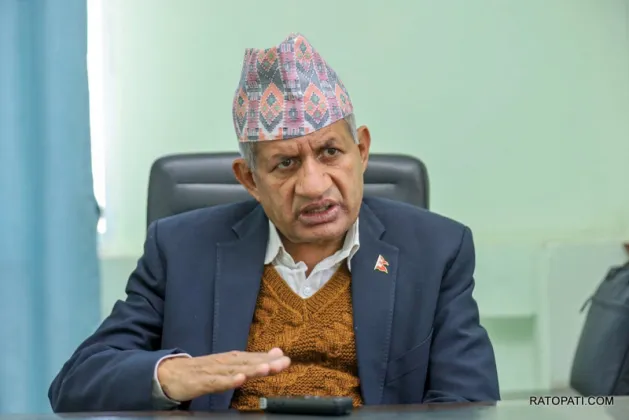
CPN-UML leader and former Foreign Minister Pradeep Gyawali has called on Nepal to adopt an independent, balanced and trust-based foreign policy, arguing that the country's geographical position and historical background leave it no room to join the strategic bloc of any major power. Speaking at a seminar in Kathmandu on Monday, Gyawali said a smaller country in Nepal's location survives on credibility and equilibrium rather than alignment, and he issued a blunt warning: if distrust grows between Nepal and its neighbours, the country cannot withstand the pressure that follows.
An independent and balanced course, not a strategic camp
The central message Gyawali carried to the Kathmandu seminar was that Nepal's diplomacy should remain firmly non-aligned. According to a report by RatoPati, the former foreign minister told the gathering that Nepal should not join the strategic bloc of any major power, a position he grounded in two considerations: the country's geography and its historical background.
In a region where rivalries among larger states constantly pull smaller capitals toward one camp or another, Gyawali presented that stance as a practical necessity rather than an abstract principle. For a country wedged between two of the world's most populous nations, the capacity to maintain ties with all sides while belonging to no alliance is what preserves diplomatic space, and that, he argued, is why alignment is a road Nepal cannot afford to take. Independence and balance, in this framing, are not slogans but the conditions under which a small state protects its interests.
The key points of his address can be summarised as follows:
- Nepal's foreign policy should be independent, balanced and trust-based.
- Nepal should not join the strategic bloc of any major power.
- The country's geographical position and historical background both argue against alignment.
- If distrust grows with its neighbours, Nepal cannot withstand the resulting pressure.
Why geography and history weigh so heavily
The argument Gyawali invoked rests on facts that have shaped Nepali diplomacy for decades. Nepal is landlocked, sharing a long and open border with India to the south and the Himalayan frontier with China to the north. Its third-country trade moves largely through transit routes provided by its neighbours, and its economy depends heavily on cross-border connectivity for fuel, supplies and commerce. Few capitals in the world have their strategic options framed so directly by geography.
That reality has long underpinned Nepal's diplomatic tradition of non-alignment: friendly and balanced ties with both immediate neighbours, engagement with the wider international community, and a consistent refusal to allow its territory to be used against any country. From the country's early embrace of the principles of peaceful coexistence to its active membership of the United Nations, Nepali foreign policy has been built on the idea that a small state survives by winning trust, not by picking sides. Gyawali's remarks place him squarely in that tradition, while stressing that these principles must be actively defended rather than taken for granted.
The warning at the heart of the speech
The sharpest note in Gyawali's remarks came not in his endorsement of balance but in his warning about its opposite. If distrust grows between Nepal and its neighbours, he said, Nepal cannot withstand the pressure that follows. The observation reflects a hard truth of regional politics: for a country of Nepal's size and location, the immediate neighbourhood is not one arena of diplomacy among several but the decisive one.
Eroding trust with neighbours rarely announces itself dramatically. It shows up in trade and transit, in border management, and in the day-to-day permissions on which a landlocked economy runs. A government that loses the confidence of those around it finds its options narrowing on every front, from economic cooperation to wider international partnerships. Gyawali's point was that trust-building is therefore not a courtesy but a matter of national security, the foundation on which an independent foreign policy ultimately rests.
A familiar debate, a consistent message
Questions of alignment and balance are among the oldest debates in Nepali public life, resurfacing whenever relations with India and China, or with larger powers active in the region, come under strain. Gyawali, who has held the foreign ministry portfolio, adds a practitioner's voice to that recurring discussion, and his intervention in Kathmandu was notable for how directly he linked high principle to practical survival.
His message was consistent from start to finish: Nepal's interests are best served not by attaching itself to any power centre but by nurturing independence, balance and trust, beginning with the countries on its own borders. For a small state in a demanding neighbourhood, he made clear, that combination is not a preference. It is the only workable policy.


