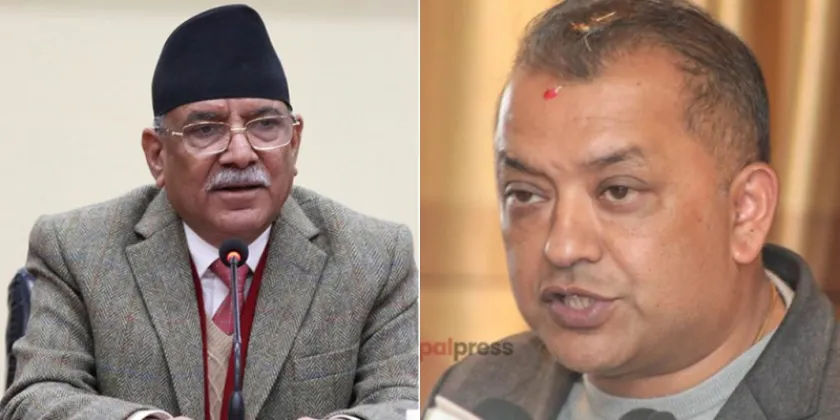
Nepali Communist Party (NCP) coordinator Pushpa Kamal Dahal 'Prachanda' said on Friday that the current government cannot arrest Nepali Congress President Gagan Thapa, speaking to journalists outside his party's central office at Parisdanda in Kathmandu. Prachanda said no one could arrest Thapa and accused the government of trying to act against the values, norms and spirit of the constitution, democracy and the republic. He described the matter as a serious concern for the country and its people.
Prachanda's warning over Thapa
Prachanda's central message was that the government could not take Thapa into custody. In his remarks to journalists, he stated categorically that no one could arrest the Nepali Congress president. The statement placed Thapa's position at the centre of Prachanda's criticism of the government, although the reported remarks did not provide further details about a specific arrest order or legal process.
The NCP coordinator framed the issue as more than a question concerning one political leader. He said the government's conduct was at odds with the constitutional and democratic principles that should guide public authority. By linking his warning about Thapa to the constitution, democracy and the republic, Prachanda presented the matter as one with implications for the country's political system and its citizens.
His comments were made while speaking to journalists outside the NCP central office at Parisdanda. The setting provided an opportunity for him to state the party coordinator's position publicly. The reported account did not include a response from the government or additional comments from Thapa, and Prachanda's remarks did not set out further detail about what action he believed the government was considering.
Allegation of a breach of democratic norms
Prachanda accused the government of trying to act contrary to the values, norms and spirit of the constitution. He also invoked democracy and the republic, arguing that the conduct he described raised a serious concern for both the country and its people. His criticism therefore went beyond the immediate claim that Thapa could not be arrested, and challenged the government's approach in broader political terms.
The language of Prachanda's statement underscored his concern about how the government was exercising its authority. Rather than presenting the issue as a routine disagreement, he characterized it as a matter tied to the principles underpinning the country's constitutional and democratic order. That characterization is Prachanda's assessment; the reported remarks did not include a detailed explanation of the alleged actions or an independent account of the government's position.
The statement also drew a distinction between the individual at the centre of the dispute and the principles Prachanda said were at stake. Thapa was the subject of his assertion about arrest, while the wider criticism focused on the government's relationship with constitutional values and democratic norms. Prachanda's warning thus addressed both the treatment of a senior opposition figure and what he described as the consequences of government conduct for the country.
A public political statement
Prachanda's comments were delivered directly to journalists, making them a public expression of concern rather than a private exchange. He did not, in the reported account, elaborate on the legal basis for his assertion that Thapa could not be arrested. Nor did the account provide details of any formal government decision concerning Thapa. The available information is therefore centred on Prachanda's warning and his criticism of the government's conduct.
By describing the issue as a serious concern for the country and its people, Prachanda emphasized the broader significance he attached to it. His remarks called attention to constitutional principles, democratic values and the republic, while making a forceful claim about the government's ability to arrest the Congress president. The statement leaves the specific circumstances behind the dispute unclear, but makes Prachanda's position plain: he opposes what he views as action against Thapa and says the government's conduct must be measured against the country's constitutional and democratic norms.