
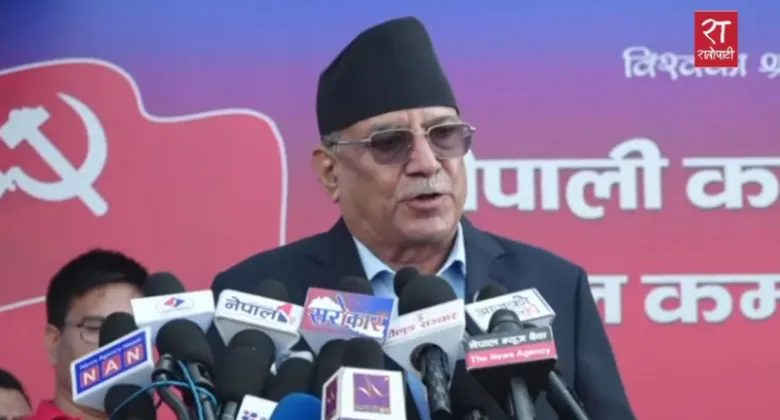
Former prime minister and Nepal Communist Party (NCP) coordinator Pushpa Kamal Dahal "Prachanda" on Tuesday delivered a pointed critique of the government, saying that impulse, prejudice and authoritarian tendencies are steadily replacing reason, thought and principle in the running of the state. Addressing a party unity programme organised at the party's central office in Parisdanda, the former premier said the state has lost its conscience and its ideas, and warned that the country's independence is now directly at stake. "If independence itself does not survive, we will not survive," he cautioned.
'The state has lost its conscience and ideas'
The central theme of Prachanda's address was a stark assessment of the condition of the Nepali state. In his view, the business of government is no longer anchored in deliberation. Reason and thought, he said, have been lost in the running of the state, and in their place have come impulse, prejudice and a growing authoritarian streak, which he characterised as reckless and authoritarian tendencies within the state.
According to a report by RatoPati, the NCP coordinator told the gathering that instead of reason, thought and principle, what is growing in the country today is impulse, prejudice and authoritarian tendencies. The formulation was as much a diagnosis as an accusation. It framed the problem not as a matter of individual missteps, but as a systemic drift away from the values that should guide public life.
The charge of authoritarian tendencies is among the most serious that a senior political figure can level against a sitting government. By pairing it with the loss of "conscience and ideas," Prachanda sought to present the problem as one of character rather than mere competence: a state, in his telling, that has stopped reflecting on what it does and why it does it.
Independence framed as an existential question
For the former prime minister, the erosion of reason in governance is not simply a domestic political concern. It bears, he argued, directly on the sovereignty of the country. Linking the two themes in his speech, he suggested that a state which has abandoned conscience and ideas cannot be relied upon to safeguard national independence.
His warning was unusually blunt for a public address. "If independence itself does not survive, we will not survive," he said, elevating the question of independence from slogan to existential stakes. In a single sentence, the NCP coordinator made clear that he views the present direction of the state as a threat not only to democratic norms, but to the survival of the nation itself.
The remarks place independence at the centre of his political message. Rather than limiting his criticism to policy disputes or administrative failures, Prachanda framed his opposition in broader terms, arguing that the quality of the state's thinking and the survival of its independence stand or fall together.
A unity programme as the stage for the warning
The setting of the remarks carried its own significance. The speech was delivered at a party unity programme held at the NCP's central office in Parisdanda, an occasion that brings party members and leaders together under one roof. Such gatherings are moments for a party to take stock of itself, and they give senior leaders a platform to speak to their own base about the state of the nation.
For Prachanda, who has served as prime minister and now leads the NCP as its coordinator, the occasion provided a stage from which to address his own cadres while framing a critique aimed squarely at the country's leadership. Speaking from his party's headquarters, he combined the language of internal unity with a wide-ranging warning about the direction of the state.
A direct challenge to the government
Taken together, the remarks amount to a direct challenge to the government's record and its style of governance. By accusing the state of losing its conscience and its ideas, of privileging impulse over reason and prejudice over principle, and of harbouring reckless and authoritarian tendencies, Prachanda has positioned himself as a critic not of this or that decision, but of the underlying character of the state today.
What is clear is that the former prime minister has chosen to make the defence of reason, principle and independence the defining note of his public message. Delivered at his own party's unity programme in Parisdanda, the warning that Nepal's independence must be maintained, or "we will not survive," now stands as his central charge against those currently in power.


