
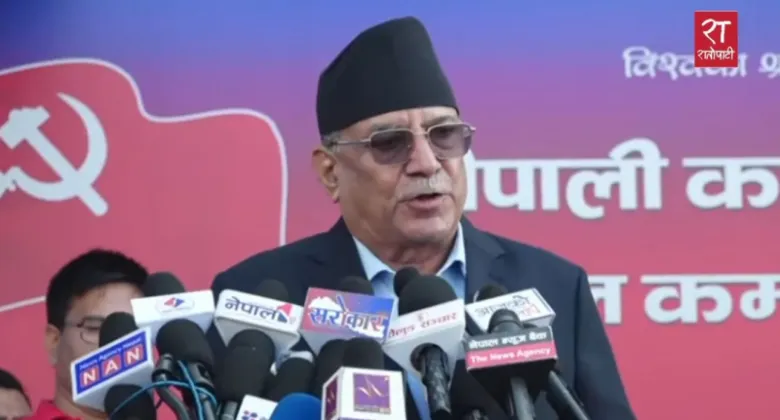
Pushpa Kamal Dahal 'Prachanda', coordinator of the Nepal Communist Party (NCP), on Tuesday issued a call for communist unity, urging forces across Nepal's left, including the UML and Maoist factions, to come together, saying the country is passing through an extraordinary crisis. Addressing a unity assembly organised with the Uma Bhujel-led NCP at the party's central office in Parisdanda, Kathmandu, Prachanda said the prevailing situation requires everyone to abandon prejudice and broaden their thinking. He also issued a pointed challenge to the communist camp: either take the leadership of the unity process into their own hands, or accept the leadership that has been initiating unity efforts.
"The country is in crisis, let's abandon prejudice and come together"
The core of Tuesday's message, as reported by Ratopati, was direct: Nepal is in crisis, and the communist movement cannot respond to it while it remains divided. Speaking to leaders and cadres gathered at the party headquarters, Prachanda described the moment as an extraordinary one for the country and argued that the responsibility for meeting it begins with the communists themselves.
According to the reports, he told the gathering that prejudice and narrow thinking within the left have held the movement back, and that everyone must now widen their outlook. The setting underlined the seriousness of the message. Rather than a public rally, the event was a unity assembly held inside the party's own central office, convened to bring the Uma Bhujel-led NCP into a shared organisational fold and to present unification as a continuing process rather than a distant slogan.
Key points from the Parisdanda address
- Nepal is passing through an extraordinary national crisis that demands a collective response.
- Communist forces, including the UML and Maoist factions, have been urged to unite.
- Prejudice and narrow thinking within the left must be abandoned, with everyone broadening their thinking.
- Communists must either take leadership of the unity drive themselves or accept the leadership already initiating unity efforts.
A direct challenge to the UML and the Maoist factions
Beyond the general appeal, the most pointed element of Prachanda's speech was the choice he placed before the communist leadership. As reported by Khabarhub, he said communists must either take leadership themselves or accept the leadership that has been initiating unity efforts. The framing effectively puts the responsibility for the pace and direction of unification on the wider communist camp, while signalling that the process currently under way will not stand still.
By directing the appeal at the UML and Maoist factions, the two major strands of the communist movement named in his address, Prachanda made clear that the unity project he envisions extends well beyond his own party's immediate membership. The assembly with the Uma Bhujel-led group served at the same time as a demonstration of intent, showing that unification is being pursued in practice, group by group, rather than merely discussed.
"Like a spider weaving a web": unity after repeated attempts
Nagarik News framed the persistence of the effort in vivid terms: like a spider weaving a web, after repeated attempts the communists will unite again. The image is a candid acknowledgment that previous rounds of communist unification have not produced a durable outcome, and at the same time an insistence that persistence will eventually pay off.
Tuesday's gathering at Parisdanda fits that pattern. The coming together of the Uma Bhujel-led NCP with the party coordinated by Prachanda represents another strand added to the web, and the public call to the UML and Maoist factions indicates that further attempts are planned. For the organisers, the message to their own cadres was that setbacks in the past do not end the effort; they justify renewing it.
What the unity call means for Nepal's fractured left
The appeal is a reminder of how fragmented Nepal's communist movement has become, with rival parties and factions competing for the same political space and, in some cases, the same political identity. Prachanda's call to "abandon prejudice" amounts to an admission that rivalry and narrow thinking, as much as ideology, have kept the left divided, and his warning that the country faces an extraordinary national crisis is intended to raise the cost of staying apart.
The challenge he posed, to lead the unity process or accept its existing leadership, now sits with the UML and the Maoist factions. Their response, and the terms on which any further engagement proceeds, will determine whether the web being woven at Parisdanda grows into a broader realignment of Nepal's left or remains confined to the groups already gathered under the NCP banner. What Tuesday's assembly made unmistakable is that the NCP under Prachanda's coordination intends to keep consolidating, and to keep the door open to the larger communist forces, in the name of a crisis it says the country can no longer afford.


