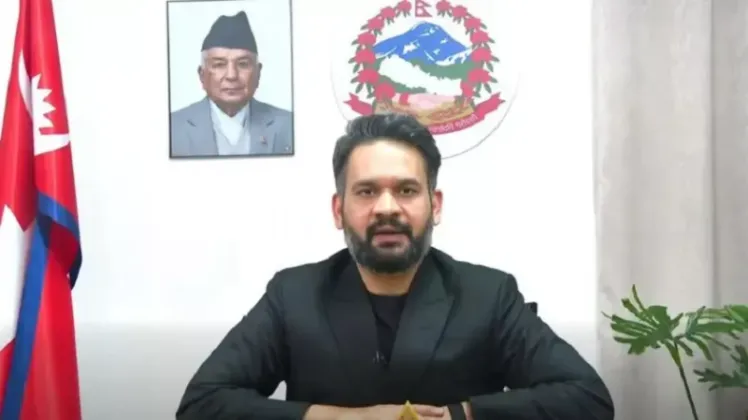
Prime Minister Balendra (Balen) Shah said on Thursday night that saving the country and saving a party are two different things, using a late-night Facebook status to draw a line between his leadership and the internal culture of Nepal's traditional political parties. In the post, the Prime Minister observed that in other parties it is the workers who fight while the leaders sit laughing, whereas in his case the leader is the one who fights and humanity is the one that hopes. The remarks, reported from Kathmandu by multiple news outlets, stand out for the directness with which Shah framed the divide between himself and the country's established political class, and for the choice of audience he addressed at the end of the sentence: not a party, but humanity itself.
'Saving the country and saving a party are different things'
Shah communicated the message on Facebook, the platform he has favored since his days in local government for speaking straight to the public rather than through press briefings or organizational channels. According to reports carried by Ratopati, Khabarhub and News of Nepal, the status set out its argument in quick succession:
- Saving the country and saving a party are different things.
- In other parties, the workers fight while the leaders sit laughing.
- In his case, the leader fights and humanity hopes.
The brevity of the post did little to blunt its force. Within a few sentences, the Prime Minister separated the fate of the nation from the survival of any political organization, and then described the distribution of struggle inside parties in unflattering terms. Where cadres and workers elsewhere shoulder the fight, he suggested, leaders watch from the sidelines; in the arrangement he described as his own, the fighting is done at the very top.
The image he chose
The language was pointed. By referring to "other parties," Shah implicitly placed himself outside that category, positioning his leadership as something distinct from the party-centered politics that has defined Nepal for decades. His use of the word "humanity" in place of terms such as supporters, cadres or members widened his stated constituency to its broadest possible reach: not a party faithful awaiting rewards, but people as such, looking to a leader who fights.
A leader who came up outside the party system
The remarks carry particular resonance given Shah's own route to power. A rapper and structural engineer before entering public life, he contested the 2022 local elections as an independent candidate and was elected mayor of Kathmandu Metropolitan City, defeating rivals backed by the established parties. His tenure in the capital built his reputation for direct communication, much of it conducted through social media, and for a style that deliberately kept its distance from the committee culture of traditional politics.
That trajectory continued to the prime minister's office, and Thursday night's status suggested he regards that distance as central to what he offers. The distinction at the heart of the post reflects the journey: he did not ascend through the layered structures of a party organization, and his framing placed the struggle, and therefore the responsibility, with the leader himself rather than with an army of workers below him. In his telling, that inversion is not a weakness but the point.
The critique embedded in the post
Read against Nepal's broader political landscape, the status joins a long-running public conversation about the dominance of party structures in national life. Political power in the country has for decades flowed through a small set of established parties, and criticism of their internal cultures, including the gap between the effort of grassroots workers and the comfort of senior leaders, is a recurring theme of public debate. Shah's formulation gave that critique a compact, memorable shape: workers fight, leaders laugh.
The inverse half of the image was equally deliberate. If other parties are defined by leaders who sit watching while others struggle, his own leadership was presented as the reversal of that pattern, a leader who fights while the wider public looks on in hope. The framing casts his accountability as running to the country at large rather than to any organization, echoing the opening line of the post itself: the country is one thing, the party another.
What the reports said
The status was reported from Kathmandu by multiple outlets following its publication on Thursday night. Ratopati's report highlighted the Prime Minister's core line on the difference between saving the country and saving a party, while Khabarhub and News of Nepal carried the same remarks, reproducing the contrast he drew between other parties and his own leadership. The reports did not indicate that Shah named any party, leader or critic in the post, and no follow-up statement from the Prime Minister's side was reported by Thursday night.
For a leader who built his political identity on speaking plainly to a public frequently critical of party politics, the status was characteristic in both form and content: short, direct and addressed to the nation rather than to any organization. As of Thursday night, he had added nothing further, leaving the words as posted to carry the message on their own.