
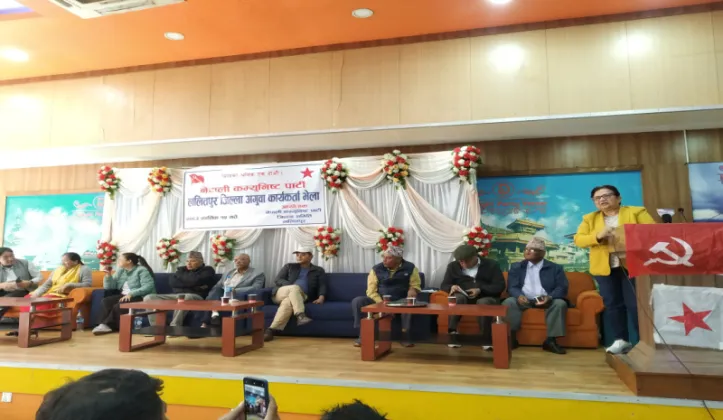
Former minister and Nepal Communist Party (NCP) leader Pampha Bhusal has said that the party must be transformed by connecting it with the people and by actively taking up the problems they face, stressing that the process of change has to begin with individual party members themselves. She made the remarks while addressing a gathering of leading cadres organised by the party's Lalitpur district committee at Mahalaxmisthan in Lalitpur. Her message to the cadres combined two themes that she presented as inseparable: reform of the party's own conduct, and a deeper, more practical engagement with the day-to-day concerns of ordinary citizens. According to reports published by Gorkhapatra Online and Ratopati, the veteran leader was speaking in her capacity as a senior figure of the party, and her address was built around the idea that the party's renewal cannot be separated from the personal example set by its own members.
Change must start with oneself
At the heart of Bhusal's address was a call for introspection. Speaking to the assembled leading cadres, she said that change must begin from oneself, making it clear that the transformation she envisions for the party is not merely an organisational exercise to be directed from above, but a matter of personal conduct that every member must practise. The message was direct: those who seek to change the party must first be willing to examine and correct their own behaviour.
This emphasis on self-transformation gave her speech a moral undertone. By telling cadres that reform starts with the individual, she placed responsibility for the party's image and credibility on the shoulders of its own workforce rather than on circumstances or on others. In her telling, the party's strength flows from the discipline and sincerity of its members, and any effort to renew the organisation must therefore begin with honest self-assessment at the personal level.
Connecting the party with the people
The second pillar of her address was the relationship between the party and the public. Bhusal said the party must be connected with the people and must engage actively in addressing their problems, positioning grassroots contact as the essential condition for the transformation she described. In her view, a party that remains close to citizens and responsive to their difficulties is the party that can genuinely renew itself.
Her remarks suggested that this connection is not a symbolic gesture but a working method. Summarised, the key messages she delivered to the cadres were:
- The party must be transformed by linking it with the people, rather than remaining distant from their lives.
- It must actively address the problems people face, treating this engagement as central to its work.
- Change must begin from oneself, with each member and leader examining their own conduct first.
- Leading cadres, as the party's front-line representatives, have a direct stake in embodying both of these commitments.
Taken together, these points present a consistent argument: the party's revival and its closeness to the public are two sides of the same coin. A member who has reformed himself or herself, in Bhusal's framing, is better placed to serve the people; and a party that serves the people credibly is a party that has truly changed.
Cadre-level gathering in Lalitpur
The setting of her remarks was significant in its own right. The gathering was organised by the NCP's Lalitpur district committee at Mahalaxmisthan and brought together the party's leading cadres from the district, giving a senior leader and former minister a direct platform to communicate her message to the party's grassroots functionaries. Rather than a public rally or a press event, this was a cadre-level meeting, the very audience that would be expected to carry such a message into wards, neighbourhoods and communities across the district.
For the cadres present, the address served as both instruction and expectation-setting. Bhusal's choice to speak about self-reform and public service before this audience underlined what she believes the party's intermediate leadership should look like: members who hold themselves to the standard they promote, and who remain visible and active where people's problems actually arise. The venue in Lalitpur, one of the districts surrounding the capital, placed that message squarely within a party structure working at the local organisational level.
A message of self-reform and public service
Bhusal's address stands out for the way it ties organisational renewal to personal example. Her argument to the leading cadres in Lalitpur was that a party cannot be transformed by declarations alone; it is transformed when its members change themselves and then take that changed outlook into the lives of the people they claim to represent. As a former minister speaking within her own party's district structure, she framed the task ahead in simple terms: connect with the people, work on their problems, and let that work begin with oneself. Whether the cadres who heard her at Mahalaxmisthan translate that message into practice will now be the measure of the call she made.


