
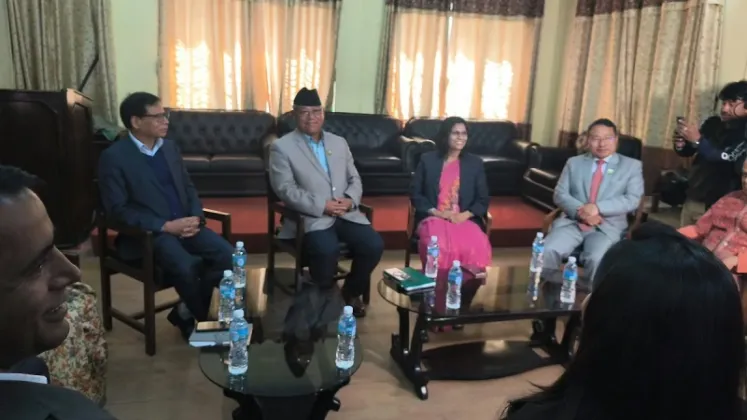
The main opposition Nepali Congress on Monday convened a meeting of the opposition parties represented in Nepal's Federal Parliament at its parliamentary party office in Singha Durbar, Kathmandu, where the participants jointly accused the government of attempting to rule through ordinances and demanded the immediate convening of a new parliamentary session. Representatives of the CPN (UML), the Nepal Communist Party and other parties took part in the discussions, which centred on the country's current political developments and on forging a common position that the opposition intends to carry onto the floor of the Federal Parliament.
Opposition Parties Gather at Singha Durbar
The meeting was held at the Nepali Congress parliamentary party office within the Singha Durbar complex in Kathmandu, bringing together delegates from the parties that sit in opposition to the government in the Federal Parliament. The Nepali Congress, as the main opposition force in the house, took the initiative to call the gathering, which was attended by representatives of the CPN (UML), the Nepal Communist Party and other parties, according to a report by Ratopati.
Two items dominated the agenda. The first was a review of the current political developments in the country, a theme that has kept Nepal's opposition parties engaged as they assess the direction of the government. The second was the pursuit of a common position in parliament, an effort to ensure that the opposition parties respond to those developments with a coordinated voice rather than through scattered, party-by-party reactions when the legislature reconvenes.
Accusations of Rule by Ordinance
The sharpest criticism to emerge from the meeting was directed at the government's handling of lawmaking. The opposition parties accused the government of trying to rule through ordinances, a charge that goes to the heart of how policy is made in Nepal's federal democratic system. An ordinance is a temporary measure that a government can promulgate when the Federal Parliament is not in session, giving it the force of law until the house reconvenes and decides its fate. Critics argue that relying on such instruments sidesteps the debate, scrutiny and amendment that ordinary legislation must pass through in parliament.
For the parties gathered at Singha Durbar, the ordinance issue and the demand for a session are two sides of the same coin. If the government is resorting to ordinances, the opposition contends, it is because parliament is not sitting, and if parliament is not sitting, the opposition's ability to challenge the government on the floor is curtailed. By demanding the immediate convening of the session, the opposition is effectively arguing that the proper venue for the country's political questions is the elected legislature itself, not executive orders issued outside it.
Demand for Immediate Session
The meeting's most concrete outcome was a shared demand that the Federal Parliament session be convened without delay. The parties framed this not as a procedural formality but as a democratic necessity, contending that the questions raised by current political developments deserve to be debated in the house where the country's elected representatives sit. The demand puts the onus squarely on the government, since in Nepal's system a new session is summoned on the basis of the government's recommendation.
The key messages that emerged from Monday's meeting can be summarized as follows:
- The government is attempting to govern through ordinances rather than through the parliamentary process.
- A session of the Federal Parliament must be called immediately.
- The opposition parties will work toward a common position in the house on current political developments.
Key Takeaways from the Meeting
The unified stand on these points marks the clearest signal yet of how the opposition intends to conduct itself once parliament returns. Rather than advancing separate agendas, the parties that met on Monday have chosen to coordinate their response to the government's approach, beginning with the shared allegation that ordinances are being used in place of open legislative deliberation.
A Show of Opposition Coordination
Beyond its immediate demands, the meeting served as a display of coordination among the opposition parties. The presence of representatives from the CPN (UML) and the Nepal Communist Party alongside the Nepali Congress indicated that concern over the government's approach is shared across the opposition benches. Building a common position in parliament is a demanding task in Nepal's multi-party landscape, and Monday's gathering at Singha Durbar represented a step toward aligning the parties' responses to the issues before the country.
The symbolism of the venue was also notable. Singha Durbar, the complex in Kathmandu that houses many of Nepal's key government institutions, provided the backdrop for a meeting whose central message was that governance should be accountable to the legislature that sits within reach of its walls.
What Comes Next
What happens next depends in large part on the government's response. The opposition's demand leaves the ball in the government's court to recommend the summoning of parliament. Meanwhile, the parties that met at Singha Durbar on Monday have signalled their intention to arrive at any future session with a shared agenda, united around the argument that Nepal's laws and political questions belong before the elected Federal Parliament rather than being settled through ordinances. As reported by Ratopati, the meeting began on Monday afternoon at the Nepali Congress parliamentary party office and continued as the parties worked to agree on a joint line.


