
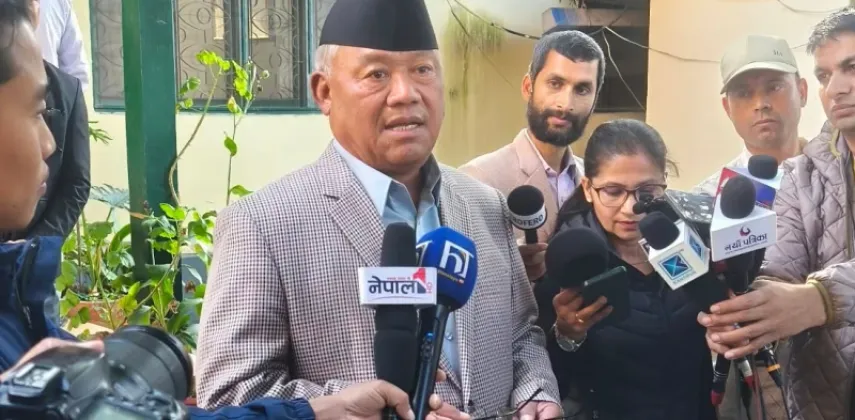
The opposition parties in Parliament will not forge a common position on the impeachment of a judge until the ruling side makes its own stance clear, Nepali Congress parliamentary party leader Bhishmaraj Angdembe said on Monday. Speaking to journalists after a meeting of opposition parties held at the Nepali Congress parliamentary party office in Kathmandu, Angdembe said the opposition is currently in a wait-and-watch situation because the ruling side itself has not settled the matter. He also underlined that on a serious issue like impeachment, both the party and the parliamentary party must be clear. His remarks, reported by RatoPati and Khabarhub, signal that the opposition does not intend to announce a coordinated response to the impeachment until the parties anchoring the government reveal where they stand.
Ruling side yet to settle the matter
At the heart of Angdembe's comments is a simple charge: the ruling party is not clear about the impeachment. In his telling, this absence of clarity is what has frozen the opposition's own deliberations. Rather than rushing to announce a joint position, the opposition parties have chosen to observe how the situation develops within the ruling side, he told journalists after Monday's meeting.
The wait-and-watch posture, as he described it, is not a sign of indifference. It reflects a calculation that any common opposition position would be premature, and possibly incoherent, while the ruling side has yet to settle its own line on the issue. Angdembe's message was that the opposition's next step depends directly on what the ruling side decides.
Summarising his key remarks:
- The opposition will form a common position on the judge's impeachment only after the ruling side makes its stance clear.
- The opposition is in a wait-and-watch situation because the ruling side itself has not settled the matter.
- On a serious issue like impeachment, the party and the parliamentary party must be clear.
Serious issue demands clarity at every level
Angdembe's remark that the party and the parliamentary party must be clear on an issue like impeachment points to the two levels at which such decisions are processed. The parliamentary party is the forum through which a party's lawmakers act in the House, while the party itself takes broader political calls that bind its organisation and its elected members alike. By insisting that both must be clear, he indicated that no position on the impeachment should be announced until the party's internal stance and its House-level line are fully aligned.
The emphasis on seriousness is telling. Impeachment is not an ordinary parliamentary matter; it touches the judiciary and carries consequences that outlast a single session of Parliament. Angdembe's comments suggest that, in his view, such a subject cannot be handled through improvisation or shifting statements, and that coherence between the party and its parliamentary party is a precondition for any public stance.
Opposition parties confer in Kathmandu
The meeting that produced these comments took place on Monday at the Nepali Congress parliamentary party office in Kathmandu, where opposition parties gathered to discuss the impeachment and their response to it. Angdembe briefed journalists soon after the meeting concluded, framing its outcome as a decision to wait rather than a decision to act.
While the opposition parties are expected to continue consulting each other, he indicated that a common position will be formed only once the ruling side's stance becomes clear. Until then, the parties will hold their respective views while coordinating on the way forward. This approach leaves room for the opposition to unite quickly if and when the ruling side clarifies its position, without committing any party to a course of action it may later need to revise.
Why the ruling side's stance matters
The importance Angdembe attaches to the ruling side's position reflects how impeachment works in practice. As the side that anchors the government, the ruling parties shape the parliamentary arithmetic on which any such motion depends. If the ruling side has not settled its own view, the opposition cannot know whether it is responding to a proposal that is advancing, stalled or still being debated within the government ranks.
For the opposition, remaining uncommitted also carries political advantages. It avoids the perception that the opposition is either driving the impeachment forward or blocking it prematurely, and it preserves flexibility as new information emerges. Angdembe's framing suggests the opposition wants to be seen as measured and procedurally careful on an issue as weighty as the removal of a judge.
For now, the ball lies with the ruling side. Angdembe's remarks make clear that the opposition's common position on the judge's impeachment stands ready to take shape, but only after the ruling side ends the uncertainty and states clearly where it stands.


