
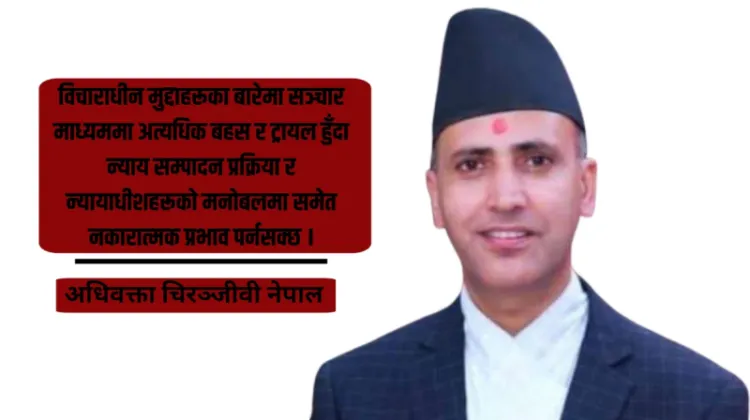
Three opinion articles published on November 1, 2026, have placed the Inam Sapkota case at the centre of a debate on the condition of Nepal's judiciary, arguing that the case has shaken an institution widely regarded as the most important of the state's three branches. The pieces, carried by Nepali news portals including Pradesh Khabar and Global Aawaj, contend that the courts' standing as the protector of citizens' rights and as the centre of the public's faith has been eroded. Among the contributors is advocate Chiranjibi Nepal, whose article adds a legal practitioner's voice to the discussion.
A shaken pillar of the state
The starting point shared by the three articles is the place the judiciary occupies in Nepal's constitutional order. The writers describe it as one of the three organs of the state, standing alongside the legislature and the executive, and they go a step further by arguing that it is seen as the most important of the three. That standing, in their view, is tied to the judiciary's role as the branch on which citizens rely when their rights are at stake. It is precisely this position, the articles contend, that the Inam Sapkota case has called into question.
None of the pieces treats the case as an isolated legal matter. Each connects it to what the authors describe as a wider crisis facing the judiciary, presenting the episode as a shock to an institution whose standing depends on how it is perceived as much as on how it functions. The shared argument is direct: the damage from the case does not remain confined to those immediately involved in it, but extends to the judiciary as a whole.
Erosion of public faith and weakened protection
The most pointed claim running through the articles concerns trust. The writers argue that the courts' standing as the protector of citizens' rights has been eroded, and that the judiciary's position as the centre of the public's faith has weakened along with it. The two losses, in their presentation, cannot be separated: a judiciary can safeguard rights only for as long as citizens believe in it and bring their grievances to it, and once that belief is damaged, the institution's central function is placed at risk.
The core arguments across the three pieces
- The judiciary, together with the legislature and the executive, forms one of the three branches of the state, and is regarded as the most important among them.
- The Inam Sapkota case has shaken the judiciary as an institution.
- The courts' standing as the protector of citizens' rights has been eroded.
- The judiciary's position as the centre of the public's faith has been weakened.
For the authors, this erosion is not an abstract worry. The authority of the courts in a democratic order rests on the confidence of the people they serve, and the articles present the loss of that confidence as the clearest available measure of the crisis now confronting Nepal's judiciary.
A practitioner's voice in a same-day debate
That the commentary includes advocate Chiranjibi Nepal is significant in itself. As a member of the legal profession, Nepal writes about the courts from within the community that engages with them daily, and his participation indicates that concern over the judiciary's standing reaches beyond outside commentators to those closest to the institution. His article stands alongside the other two in arguing that the case has shaken the judiciary and weakened its role as the guardian of citizens' rights.
The three articles appeared on the same day, November 1, 2026, across separate platforms, with the pieces accessible through Pradesh Khabar and Global Aawaj. Their simultaneous publication points to the Inam Sapkota case becoming a shared reference point for writers assessing the state of the judiciary, and to the questions it raises being discussed across different outlets at the same time.
A moment of reckoning for the courts
Taken together, the three pieces frame the Inam Sapkota case not as a standalone controversy but as a moment of reckoning for an institution that sits at the centre of Nepal's constitutional structure. Because the judiciary stands alongside the legislature and the executive as one of the three branches of the state, the writers' argument carries an implication for the system as a whole: a crisis in the courts is a crisis felt across the structure of governance, since the branches exist in balance with one another.
The consistent message across the articles is that the measure of the judiciary's health lies not only in its rulings but in the confidence citizens place in it. By that measure, the writers argue, the Inam Sapkota case has left the institution visibly weakened: shaken in its standing among the three branches of the state, diminished as the protector of citizens' rights, and no longer the unquestioned centre of the public's faith. That is the warning at the heart of all three articles.


