
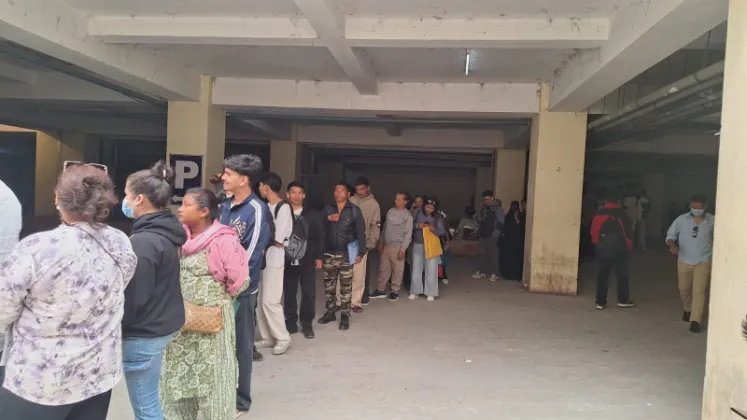
KATHMANDU - Service seekers who booked online appointments at the Passport Department in Tripureshwor, Kathmandu, are still being forced to wait in queues for hours, despite holding confirmed slots for the date and time of their visit. According to reports published by Nepal Views and Pradesh Khabar, applicants complain that they do not receive service at their scheduled times even after booking through the online system, and the resulting delays have caused serious hardship for the people arriving at the department.
An appointment system that stops at the door
The online appointment system is meant to make a visit to the Passport Department predictable. An applicant books a slot in advance, arrives at the appointed hour, completes the required formalities at the counter and leaves without the uncertainty of an open-ended queue. On paper, it is a straightforward arrangement that should protect both the applicant's time and the department's workflow.
In practice, as service seekers describe it, that promise ends at the gate. Applicants who arrive with their appointment bookings in hand say their slots count for little once they enter the department. Instead of being attended to at their scheduled time, they find themselves standing in queues that stretch on for hours, watching their appointment windows come and go.
The complaint is not with the booking process itself, which service seekers are evidently able to complete; what fails is what follows. Their scheduled times are not honoured, and the order in which people are called to the counters does not appear to reflect the slots they were assigned. The result is a system where a document that is supposed to guarantee timely service instead becomes the first step in a long wait.
Among the key points highlighted in the reports:
- Applicants who booked online say they are not served at the times they were given.
- Queues at the Tripureshwor office stretch for hours, even for those with confirmed appointments.
- The problem is described as persistent rather than a one-day disruption.
- The delays are causing real hardship for people who planned their days, and in some cases their travel, around a specific appointment time.
Hardship behind the queues
For the people standing in these lines, a passport is rarely a casual errand. Passports are needed for foreign employment, for study abroad, for family travel and for a range of other purposes where timing matters. An applicant who has arranged documents, leave from work or a trip to Kathmandu around a confirmed appointment expects that appointment to hold. When it does not, the cost is borne by the service seeker.
Hours spent in a queue mean lost income for those who work by the day, missed commitments for those with jobs and businesses to run, and extra expenses for anyone who has travelled to the capital and must now extend their stay. Older applicants and those less able to endure long periods of standing are left waiting with no clear answer about when their turn will come.
There is also a deeper frustration at play. Applicants followed the rules laid down by the department: they booked online and they arrived at their allotted time. The difficulty they face is not of their own making, which is precisely why the complaints are so pointed. Service seekers are asking, in effect, for the system to work as it was designed to work, with appointment times that mean what they say.
The persistence of the problem also raises questions about the credibility of digital service delivery more broadly. Online appointment systems are adopted to reduce crowding, remove discretion from queue management and give citizens certainty. When booked slots are not honoured, applicants may reasonably wonder what the online booking is actually for, and confidence in the wider shift toward digital public services suffers accordingly.
Closing the gap between slot and counter
What the reports suggest is that the bottleneck lies not in how appointments are made but in how they are executed at the Tripureshwor office. The booking side of the process exists; the queue management side is not keeping pace with it. Bridging that gap, the experience of service seekers indicates, requires that the department treat scheduled times as commitments rather than suggestions, and that applicants receive clear information when delays occur.
For now, the scene at the Passport Department in Tripureshwor remains what it has been: long lines of people holding appointment confirmations, waiting hour after hour for a service they were promised at a specific time. Until the department is able to match its counters to its calendar, the online appointment system will continue to fall short of the one thing service seekers need most from it, which is to be served when they are scheduled to be served.


