
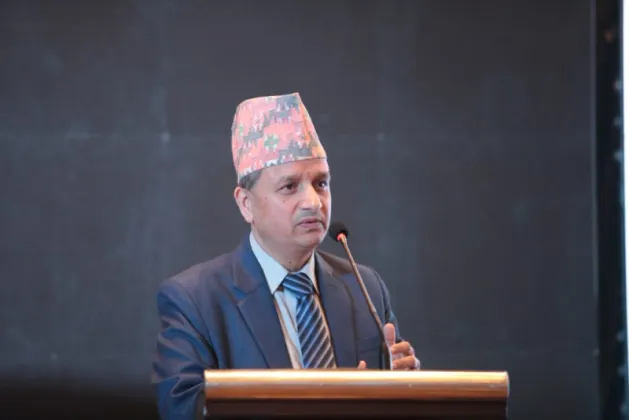
National Planning Commission (NPC) Vice Chair Gunakar Bhatta has said that public and private investment in Nepal should complement, rather than compete with, each other if the country's development is to be balanced, inclusive and decentralised. He made the remark while speaking at a programme organised by the Nepal Economic Journalists Society (SEJON) in Kathmandu on Tuesday, using the platform to outline how he believes the state and the private sector should share the task of financing national development. His comments were reported by Nepal Press and Khabarhub.
Complementary, not competitive
At the heart of Bhatta's address was a clear proposition: the two main engines of development finance, the public purse and private capital, should not crowd into the same ground in a way that pits one against the other. Instead, he argued, they should be arranged so that each reinforces the other, with the state and the private sector each doing what it is best placed to do.
The NPC vice chair framed this complementarity as the route to the kind of development Nepal needs: growth that is balanced across regions and sectors, inclusive in whose benefits it reaches, and decentralised so that opportunity is not concentrated in a single centre. In his telling, the question is not whether public or private investment should lead, but how the two can be positioned to pull in the same direction.
The distinction he drew carries practical weight. Where public and private money compete head to head, one form of capital can end up displacing the other. Where they are deliberately matched, however, each can build on the strengths of the other, extending the reach of development rather than duplicating its efforts.
Getting more out of public investment
The first pillar of his remarks concerned the quality of public spending. Bhatta stressed the need to raise the effectiveness of public investment and the returns it generates, a point that speaks directly to how well state resources translate into development outcomes that citizens can actually feel.
Public investment, in his framing, should not be judged simply by how much is spent. Its value lies in what that spending delivers. Raising effectiveness and returns, he indicated, is what allows public money to serve as a credible foundation for the balanced, inclusive and decentralised development he described, rather than an end in itself.
Taking private capital where the state has not reached
The other side of his equation was the private sector. Bhatta called for private investment to be attracted into sectors that the government has not yet reached, positioning private capital as a means of closing the gaps that public provision alone has not filled.
This, too, ties back to his central theme. If private investment flows into areas and industries that the state has been unable to serve, the benefits of growth can spread more widely, reaching communities and segments of the economy that would otherwise remain outside the development mainstream. That is precisely the inclusive and decentralised pattern of development he said the country should be pursuing.
A three-way test for investment decisions
Beyond the division of labour between the state and the private sector, Bhatta also set out how investment, whether public or private, should be judged. He said the two forms of investment should move ahead in a balanced way while being assessed against three yardsticks:
- Economic returns: the financial and productive gains an investment is expected to generate for the wider economy.
- Social returns: the broader benefits an investment delivers to communities and society, beyond what appears in a ledger or budget line.
- Environmental risks: the potential pressure a project could place on the natural environment, which he said must be weighed alongside the returns it promises.
Holding the three tests together matters because a project that performs well on one count can falter on another. By insisting that economic gains be read alongside social benefit and environmental risk, Bhatta's formulation asks both the government and private investors to weigh the full consequences of where capital is deployed.
A platform for economic debate
The programme in Kathmandu was organised by SEJON, a society of journalists who cover economic affairs, and offered a forum in which a senior policymaker could set out his thinking before the reporters who follow the economy day to day. For Bhatta, vice chair of the country's apex planning body, it was an occasion to signal how the respective roles of public and private money should be treated in the planning that lies ahead.
His prescription, in short, was that public and private investment should stop viewing each other as rivals and start operating as partners, with each judged not only by what it earns but by what it returns to society and what it risks to the environment. That, he argued, is how Nepal's development becomes balanced, inclusive and decentralised.


