
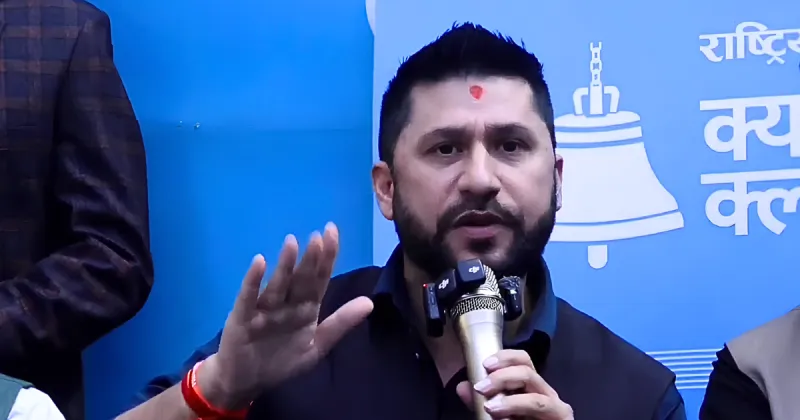
Kathmandu - Rastriya Swatantra Party (RSP) chairman Ravi Lamichhane said on Saturday that no one is above the constitution and democracy, adding that those who violate them should be punished. He made the remarks while speaking to journalists after a secretariat meeting of the party held in Kathmandu, according to reports published by Nagarik News, Nepal Press and Ratopati. The statement, delivered immediately after an internal party gathering, was framed by the RSP chairman as a clear articulation of where his party stands on questions of constitutional supremacy and democratic norms.
"No one is above the constitution and democracy"
Speaking to reporters outside the venue of the secretariat meeting, Lamichhane said the RSP's position on the primacy of democratic practice and the constitutional order was unambiguous. According to Nagarik News, he told journalists that no individual stands above the constitution and democracy, and that those who violate them should face punishment.
The key points of his remarks, as reported by the Nepali media outlets that covered the interaction, can be summarised as follows:
- No one is above the constitution and democracy, a principle he said applies to everyone without exception.
- The RSP is clear on the supremacy of democracy and the constitution, a stance he reiterated on behalf of the party following its internal meeting.
- Anyone who abuses rights granted by the constitution must face punishment, he said, linking the enjoyment of constitutional rights to accountability for their misuse.
Lamichhane's comments placed the constitution at the centre of his party's public messaging. By stating that the RSP is "clear" on the supremacy of democracy and the constitution, he presented the party's position as settled and consistent, rather than a reaction to any single issue. The formulation that no one stands above the constitution and democracy echoed a widely invoked principle in Nepal's public discourse: that constitutional provisions bind every citizen, office holder and institution equally, and that democratic governance rests on respect for that supremacy.
"Anyone who abuses constitutional rights should be punished"
A significant element of Lamichhane's remarks was his insistence on consequences for the misuse of constitutionally granted rights. As reported by Nepal Press under the headline framing that anyone who misuses constitutional rights should be punished, the RSP chairman drew a direct line between the rights the constitution guarantees and the responsibility that comes with exercising them.
In other words, Lamichhane argued that constitutional rights are not a shield. The same framework that protects freedoms also demands that those freedoms be exercised within lawful bounds, and that violations should carry penalties. This pairing of rights and punishment for their abuse formed the core of his message to the press after the meeting.
His comments, as summarised across the coverage, carried three linked ideas:
- Constitutional and democratic supremacy is non-negotiable.
- Rights granted by the constitution are meant to be exercised responsibly.
- Abuse of those rights must invite punishment under due process.
For a party chairman speaking on the record, the statement served both as a normative claim about the constitutional order and as a statement of the RSP's own position. Lamichhane did not limit the principle to any particular group; the standard he described, that no one is above the constitution and democracy, was presented as universal.
Statement follows party secretariat meeting
The remarks came after a secretariat meeting of the RSP held in Kathmandu on Saturday. Secretariat meetings are the forum in which a party's top leadership discusses organisational and political matters and settles positions on issues of the day. That Lamichhane chose to brief journalists immediately afterwards suggests the party wanted its stance communicated publicly and in the chairman's own words.
By front-loading the message that the RSP is "clear" on democracy and the constitution, the party chairman positioned the statement as an official articulation of the party line rather than a personal observation. The consistency of the message across the coverage by Nagarik News, Nepal Press and Ratopati indicates that the emphasis on constitutional supremacy and punishment for violations was the central takeaway from his interaction with the press.
Rule of law at the centre of the message
At its heart, Lamichhane's Saturday statement was a rule-of-law message. The assertion that no one is above the constitution and democracy underscores equality before the law, while the call to punish those who abuse constitutionally granted rights speaks to accountability. Together, the two strands form a coherent position: the constitutional order is supreme, participation in democratic life is bounded by responsibility, and breaches of that order should not go unaddressed.
Statements of this kind matter in a political environment where debates over adherence to constitutional norms and democratic practice are a recurring feature of public life. By stating that the RSP's commitment to constitutional and democratic supremacy is firm, Lamichhane sought to place his party squarely on the side of that order, while also signalling that his party views accountability, including punishment for abuse of rights, as an integral part of constitutional democracy rather than an afterthought.
What was said, in brief
To recap the RSP chairman's Saturday remarks to journalists in Kathmandu:
- No one is above the constitution and democracy, and violators should be punished.
- The RSP is clear on the supremacy of democracy and the constitution.
- Abuse of constitutionally granted rights must attract punishment, he added.
The comments, made after the party's secretariat meeting in the capital, were reported by Nagarik News, Nepal Press and Ratopati, each of which highlighted the dual message of constitutional supremacy and accountability that Lamichhane delivered on behalf of his party.


