
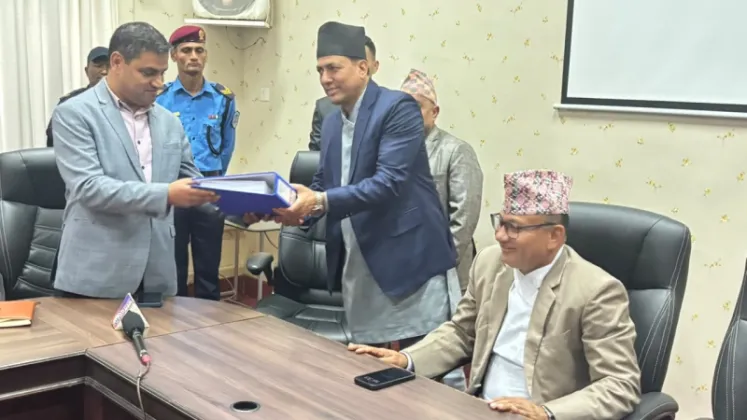
Kathmandu - The Nepali Congress has submitted the details of its newly elected central committee to the Election Commission, filing a formal application at the commission to update the party's official records with its new leadership, in a development reported on November 2, 2026. The step places the composition of the party's top organizational body on record with Nepal's election authority, completing an important administrative follow-up to the party's recently concluded internal election process.
According to reports published by Nepal Views and Nepal Samaya, the party filed an application at the Election Commission with the specific purpose of updating the commission's records to reflect the new committee. Some reports referred to the body as the party's newly elected working committee, underlining that the submission concerns the same central organizational structure that will now guide the party's affairs going forward.
A Formal Filing to Bring Records Up to Date
The submission centers on a simple but consequential act of party administration. Political parties in Nepal operate under a framework in which their organizational details are maintained by the Election Commission, and any change in the composition of a party's principal committee needs to be communicated to the commission so that its registers remain accurate. By filing the application, the Nepali Congress has initiated that process for its new central committee.
The key elements of the submission can be summarized as follows:
- Who: The Nepali Congress, one of Nepal's major political parties.
- What: An application containing the details of the party's newly elected central committee.
- Where: Filed at the Election Commission.
- Purpose: To update the commission's records with the new committee.
- When reported: November 2, 2026.
Until the commission's records are updated, the details of the party's earlier committee would remain the reference point in its files. The application seeks to replace those details with the particulars of the committee that has now been elected, ensuring that the official record matches the party's current leadership.
The Election Commission's Role in Party Administration
The Election Commission occupies a central place in the administration of political parties in Nepal. As the body that maintains records related to the parties on its register, it relies on the parties themselves to keep their submitted information current. Submissions such as the one filed by the Nepali Congress are the mechanism through which a party informs the commission that its leadership structure has changed.
An accurate, up-to-date record serves several practical functions. It allows the commission to know which individuals constitute the party's central committee at any given time, and it provides an authoritative reference for the party's organizational details. For the party, having its records aligned with its newly elected committee removes any ambiguity about who formally leads the organization in the eyes of the election authority.
The filing by the Nepali Congress follows this established pattern. Through its application, the party has asked the commission to recognize and record its new central committee, bringing the commission's documentation in line with the outcome of the internal election.
Significance for the Party
For any major party, the submission of a new committee's details to the Election Commission marks the formal transition from an election result to an officially recorded leadership structure. In the Nepali Congress's case, the filing reported on November 2, 2026, signals that the party has moved to complete the paperwork that accompanies its new central committee.
From Election Result to Official Record
The timing is also worth noting. Internal elections generate a new set of office bearers whose authority within the party is settled by the party's own process. Communicating those changes to the Election Commission is what gives the new committee a presence in the official records of the state. With the application filed, the Nepali Congress has taken that step for its newly elected body.
The submission also underscores the routine yet essential nature of party administration. Conventions and internal elections attract headlines, but the subsequent updating of records with the Election Commission is what allows a party's new leadership to function as a matter of record. The Nepali Congress's filing reflects that operational discipline, ensuring that the party's documentation keeps pace with its organizational reality.
What Comes Next
With the application submitted, attention now turns to the Election Commission's handling of the request. The commission processes such applications so that its records concerning registered parties are brought up to date. Once the update is carried through, the commission's records will show the details of the Nepali Congress's newly elected central committee in place of the earlier information.
For the party, the completion of this process will round off the administrative sequence that began with its internal election. The newly elected committee, whose details have now been lodged with the Election Commission, stands as the recorded leadership of the Nepali Congress, and the party's official file at the election authority is set to reflect that reality.


