
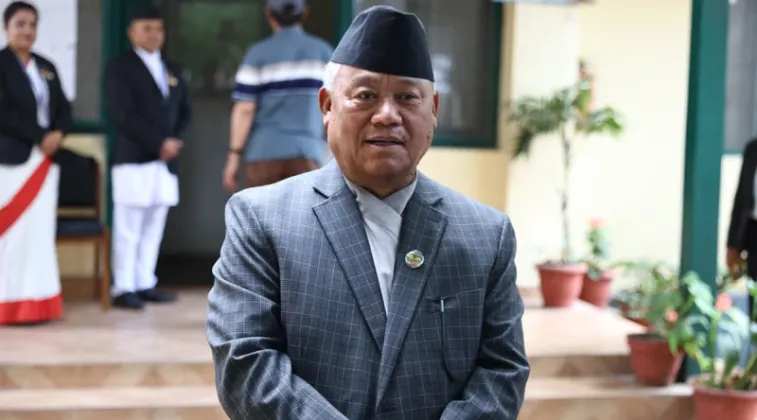
The main opposition Nepali Congress has delivered one of its harshest public verdicts yet on the country's executive, with the party's parliamentary leader declaring that the Prime Minister and Council of Ministers' Office has become like a "torture chamber." The remarks were made public on November 3, 2026, and were reported by Nepal Views. Bhishmaraj Angdembe, the leader of the Nepali Congress parliamentary party, said that "everyone has begun to feel that the Prime Minister's Office is like a torture chamber," a stark characterization of the institution that sits at the head of Nepal's government.
An unusually blunt charge from the opposition
The statement stands out both for who made it and for how it was framed. Angdembe is not a rank-and-file critic speaking off the cuff; as parliamentary party leader, he is the senior figure who leads the Nepali Congress's lawmakers and speaks with the authority of the largest opposition force in the country's politics. His decision to describe the Prime Minister and Council of Ministers' Office in such graphic terms reflects the intensity of feeling within the main opposition toward the office that directs the work of the government.
The phrasing he chose is also notable. Political disagreements are usually expressed through criticism of policies, appointments or decisions. By contrast, the "torture chamber" comparison is aimed at the character of the office itself, suggesting that in the opposition leader's view the problem is not a single measure but the atmosphere in which the institution operates. When Angdembe says that "everyone" has begun to feel this way, he is presenting the perception as widespread rather than as the grievance of a single party, an assertion intended to give the criticism broader public resonance.
The statement at a glance
- Speaker: Bhishmaraj Angdembe, parliamentary party leader of the Nepali Congress, the main opposition.
- Claim: The Prime Minister and Council of Ministers' Office has become like a torture chamber, and according to Angdembe, "everyone has begun to feel" that way.
- Target: The Prime Minister and Council of Ministers' Office, the central executive institution of the government.
- When: The remarks were made public on November 3, 2026.
What the words are meant to convey
A torture chamber is, in ordinary understanding, a place associated with coercion, fear and suffering rather than with service, deliberation or accountability. Applying that image to the office of the head of government inverts the expectations that citizens normally hold for such an institution. Instead of describing the Prime Minister's Office as a centre of decision-making and administration, Angdembe's language presents it, in the opposition's framing, as a place that people approach with dread rather than confidence.
It is important to note that this is the characterization of a senior opposition leader, offered as political criticism, and not a formal finding about the conduct of the office. Yet the choice of such severe imagery is itself politically significant. It signals that the Nepali Congress's grievance with the government is being voiced not as routine disagreement but as a deeper distrust of how power is being exercised at the very top. Statements of this kind are typically reserved for moments when an opposition wants to sharpen public attention and put the government on the defensive.
The remark also shifts the terms of debate. Criticism directed at specific policies can be answered with specific defenses. A charge that the office itself has become a place people fear is harder to rebut point by point, because it concerns perception and culture. By claiming that this feeling is now shared by "everyone," Angdembe is effectively challenging the government to disprove a sweeping public mood.
Why the speaker and the target matter
The weight of the statement comes from the positions of both the speaker and the institution he is criticizing. The Nepali Congress, as the main opposition, carries the primary responsibility in Nepal's political system for questioning and scrutinizing the government, and its parliamentary party leader is the natural voice for that scrutiny. When a figure in that role speaks, the comments are read not as a personal opinion but as a signal of the opposition's broader posture toward the government.
The target of the criticism carries equal weight. The Prime Minister and Council of Ministers' Office coordinates the work of the Council of Ministers and stands at the apex of the executive branch. Criticism of the office is therefore criticism of the heart of the government itself, and characterizations of it tend to shape how the public judges the entire administration. A description as severe as the one Angdembe used places the office's conduct and working culture squarely at the centre of political debate.
What comes next
For now, the remarks stand as a pointed expression of the main opposition's distrust of the Prime Minister's Office, made public on November 3, 2026. The immediate questions are whether the government or the Prime Minister's Office chooses to respond to so charged a comparison, and whether the Nepali Congress follows the statement with formal pressure in parliament or sustained public campaigning. Further details of Angdembe's comments are available in the report by Nepal Views.


