
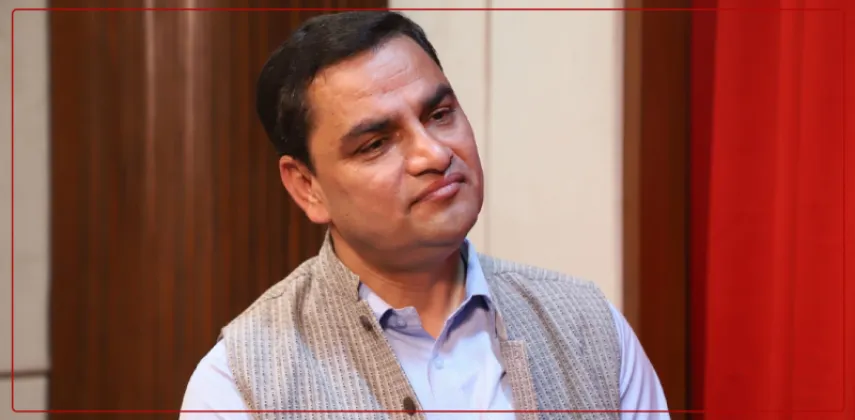
Nepali Congress General Secretary Pradip Poudel has strongly objected to the arrest of journalists by police for collecting news and making information public, describing the detentions as the height of authoritarian tendencies. In a statement shared on social media on Friday, the senior Congress leader sharply criticised the government, arguing that the arrests amounted to a deliberate attempt to stifle press freedom in Nepal. His remarks, reported by Ratopati, Nagarik News and Khabarhub, place one of the country's most prominent opposition leaders at the center of a debate over the treatment of journalists and the limits of state power.
"Arresting Journalists Is the Culmination of Totalitarian Tendencies"
Poudel pulled no punches in his assessment. According to Ratopati, he characterised the arrest of working journalists as the culmination of totalitarian tendencies, language that frames the police action not as routine law enforcement but as a symptom of a deeper authoritarian drift. In his statement, he directed his sharpest words at the government itself, holding it responsible for what he described as an assault on the press.
The core of his objection, as carried across the reports, can be distilled into a few central claims:
- Journalists were arrested by police for the basic professional acts of gathering news and making information public.
- Such arrests represent authoritarian and totalitarian tendencies at their height.
- The government's move constitutes a direct attempt to suppress press freedom.
- Investigative journalism on the activities of public office holders, judicial integrity and the abuse of power is essential to keep citizens informed.
By releasing the statement on social media, Poudel ensured it reached a wide audience quickly, and the strongly worded language underlined the seriousness with which the Nepali Congress leadership views the arrests.
A Defense of Investigative Journalism
At the heart of Poudel's statement was a forceful defense of the very kind of journalism that the arrested reporters were said to be practicing. He argued that reporting which examines the activities of public office holders, scrutinises judicial integrity and exposes the abuse of power is not an optional extra in a democracy but a necessity. Citizens, in his framing, cannot hold their leaders to account if they are kept in the dark, and journalists are the means by which that darkness is lifted.
This line of reasoning carries particular weight coming from the general secretary of the Nepali Congress, one of Nepal's principal political parties. Poudel effectively positioned the press as a partner in accountability rather than an adversary of the state. When reporters are detained for collecting information, he suggested, the loss is not borne by newsrooms alone; it is borne by every citizen who depends on that information to understand what is being done in their name.
His argument also drew an implicit line between the legitimate exercise of police authority and its misuse. According to the reports, nothing in his statement sought to defend wrongdoing. What he objected to was the arrest of journalists for the act of journalism itself, for the collection of news and its publication in the public interest.
Government Accused of Trying to Suppress Press Freedom
Beyond the defense of journalists, the statement carried a pointed political accusation. As Nagarik News reported, Poudel said attempts were made to suppress press freedom by arresting journalists, a formulation that casts the detentions as a matter of policy rather than coincidence. In his telling, the government was not merely negligent in protecting the press but actively engaged in curbing it.
That accusation goes to the heart of the dispute between the government and its critics. Press freedom is often tested not through declared censorship but through quieter actions: a journalist detained while gathering news, a report interrupted by police intervention. It is precisely such actions, Poudel argued, that reveal authoritarian tendencies, because they turn the machinery of the state against those whose only task is to inform the public.
A Warning from a Senior Opposition Leader
The statement is significant for the identity of the person making it. As general secretary of the Nepali Congress, Poudel speaks with the authority of a party long at the center of Nepal's political life. His criticism signals that the arrests are set to become a point of political contention, with the opposition framing the issue not as a law-and-order matter but as a test of the government's commitment to democratic norms.
For the government, the remarks represent a direct challenge. Poudel's language, describing the arrests as the height of authoritarian tendencies and an attempt to stifle press freedom, leaves little room for interpretation, and it sets a clear marker for how the Nepali Congress intends to position itself on the issue. Whether the government addresses the underlying concerns about journalists being detained for their reporting will now be watched closely.
What is already clear is Poudel's central message: a government that arrests journalists for informing citizens has, in his view, crossed a line that strikes at the foundations of democratic governance. The arrests, he insists, are not an isolated misstep but the culmination of a wider authoritarian impulse, and his statement makes clear that he intends to keep pressing that charge in the days ahead.


