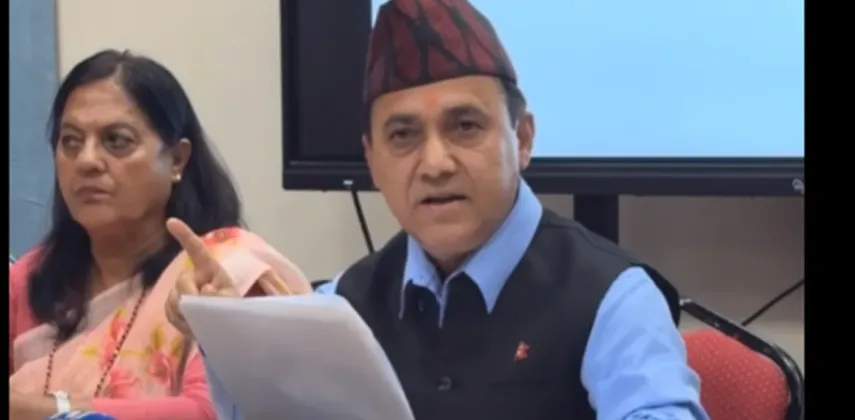
The Nepali Congress has accused the government of engineering a sponsored conspiracy against its general convention, with one of its most senior leaders declaring that allegations of financial wrongdoing surrounding the event are false and politically motivated. Senior vice-president Bishwa Prakash Sharma levelled the charge at an emergency press conference held at the party's central office in Sanepa on Wednesday, saying claims of financial irregularities in the convention were "completely false" and had been manufactured with the government's backing. The hastily called briefing, reported by RatoPati and News of Nepal, marks a sharp escalation in the war of words between the main opposition party and the authorities, and shifts the focus of the dispute from the party's internal affairs to the conduct of the state itself.
'Completely false and government-sponsored'
Sharma told journalists that the narrative of financial manipulation surrounding the general convention had no basis in fact and should be understood as part of a deliberate, state-backed attempt to damage the party. According to the reports, he described the claims as "completely false" and "government-sponsored", language that left little doubt about where the Congress believes responsibility for the allegations lies.
The decision to summon an emergency press conference at the party's central office underscores how seriously the leadership views the charges. Rather than allowing the allegations to circulate unanswered, the party moved to confront them publicly and immediately, deploying one of its highest-ranking office-bearers to deliver the rebuttal. In doing so, the Congress signalled that it regards the financial claims not as ordinary criticism but as an organised attack on the party's most important internal exercise.
The allegations in question centre on the management of finances connected to the general convention, an event that mobilises the party's organisational machinery on a national scale. By dismissing the claims as sponsored, Sharma sought to reframe the controversy: the issue, in the party's telling, is not the Congress's bookkeeping but the conduct of those circulating the story.
Charges of misused state machinery
Beyond rejecting the financial allegations on their merits, Sharma widened his attack to the behaviour of the government itself. He accused the state machinery of being misused against the opposition party, a serious charge that frames the affair not as routine political friction but as an abuse of official power directed at a political rival.
At Wednesday's briefing, the party's core assertions were clear:
- Claims of financial irregularities, or manipulation, at the general convention are entirely false.
- Those claims were sponsored by the government rather than arising from genuine concerns.
- State machinery has been misused against the opposition party.
- Statements have been leaked from detention, which the party cites as part of the same campaign.
Accusations that a government has turned state institutions against its opponents are among the gravest that can be made in a democratic system, and Sharma's choice of language reflects the depth of the party's anger. In Nepal's fiercely competitive political environment, where trust between ruling and opposition camps is often fragile, allegations of this nature carry the potential to inflame tensions well beyond a single dispute over a party event. The Congress, by placing the charge on the record at a formal press conference, has ensured that the accusation now forms part of the public political debate rather than remaining a dispute confined to party circles.
Statements leaked from detention
Among the more striking elements of Sharma's remarks was his reference to statements being leaked from detention. The reports did not specify who was in custody or the content of the statements in question, but the claim added a further layer to the party's allegations, indicating that its concerns extend beyond the financial claims themselves to the handling of individuals in detention.
By folding the leak into its broader account, the Congress presented the episode as evidence of coordination rather than coincidence. In the party's framing, the financial allegations, the misuse of state machinery and the leaking of detained statements are not isolated incidents but threads of a single, sponsored campaign aimed at its convention. That characterization places the burden squarely on the government, which has in effect been accused by the opposition of orchestrating a plot against a rival party's internal democratic process.
What is at stake for the party
The general convention sits at the apex of the Nepali Congress's organisational life. It is the forum in which the party sets its direction and renews its leadership, drawing participants from across the country. Because it is the mechanism through which the party refreshes its mandate, the integrity of the process carries weight far beyond the convention itself: questions about finances or manipulation, once raised, can cast a lasting shadow over the leadership and the decisions that emerge from it.
That sensitivity explains the urgency of the party's response. For the Congress, which stands as the principal opposition force in national politics, the defence mounted on Wednesday was not merely a rebuttal of accounting claims but a defence of the legitimacy of its most significant internal gathering. Accusations and counter-accusations over the use of state power against political opponents are a recurring fault line in Nepali politics, and this dispute has landed squarely on that fault line.
The reports did not indicate any immediate public reaction from the government side to the allegations aired on Wednesday. Attention will now turn to whether official channels respond to the charge that state machinery was misused, and whether the Congress presents further evidence to substantiate its claim of a sponsored conspiracy. For its part, the party has made its position unambiguous: it regards the financial claims as fabricated, the campaign against its convention as orchestrated, and the hand behind it as the government's own.