
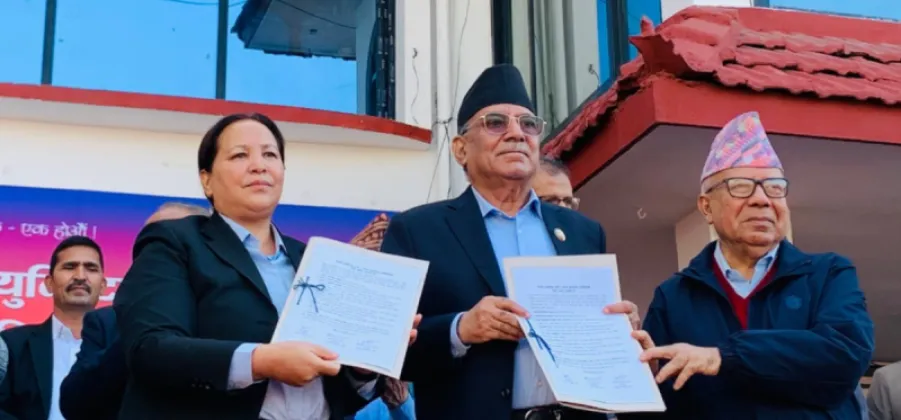
The Nepali Communist Party and the Nepal Communist Party signed a 10-point unity agreement in Kathmandu on Kartik 17, agreeing to merge under the name Nepali Communist Party and advance the process of unification. The pact also provides that the unified party will retain the five-pointed star as its election symbol and adopt Marxism-Leninism as its guiding principle. The agreement sets out a shared name, symbol and ideological basis for the parties as they move towards forming one organisation.
A shared name and election symbol
Under the agreement, the merged organisation will be called the Nepali Communist Party. The name will therefore be used by the unified party following the merger, rather than either of the two names currently used by the signatories. The name is one of the central terms identified in the 10-point pact, which the parties signed to move their unification process forward.
The agreement also settles the election symbol for the unified party: the five-pointed star. Retaining the symbol gives the merged organisation a common electoral identity under the pact. The details reported about the agreement do not describe other election-related arrangements, but they establish that the five-pointed star will remain the symbol as the parties unite.
The agreed name and symbol are two concrete elements of the merger framework. Together, they set out how the new party is to be identified publicly and in elections. The agreement thus goes beyond an expression of intent to unite, specifying some of the terms under which the unified organisation will proceed.
Marxism-Leninism as the guiding principle
The 10-point agreement states that Marxism-Leninism will be the guiding principle of the unified Nepali Communist Party. This provision identifies the ideological foundation the parties have agreed to share after the merger. Alongside the name and election symbol, it forms one of the key terms reported from the pact.
By setting out a common guiding principle, the agreement provides an ideological basis for the proposed unity. The information available about the pact does not spell out how the principle will be reflected in the party’s internal structures, policies or future decisions. It does, however, make clear that the parties have agreed on Marxism-Leninism as the unified party’s stated guiding principle.
Agreement advances the unification process
The parties described their agreement as a step to advance unification. Signing a 10-point pact establishes a framework for bringing the Nepali Communist Party and the Nepal Communist Party together, with the shared name, symbol and guiding principle among the terms identified. The pact’s stated purpose is to move the process forward; the reported details do not provide a timetable for completing the merger or describe further implementation steps.
Coverage by Nagarik News and Khabarhub reported the agreement and its provisions on the party’s name and election symbol. The pact was signed in Kathmandu on Kartik 17. The reported terms establish the direction the two parties have agreed to take, while the remaining details of the 10-point document and the next stages of unification were not specified in the information available.
For now, the central outcome is that the two parties have agreed to merge and have set out several defining features of the unified organisation. It will bear the name Nepali Communist Party, use the five-pointed star as its election symbol and follow Marxism-Leninism as its guiding principle. The 10-point accord is intended to advance the unification process, though the agreement’s reported provisions do not state when the merger will be completed.


