
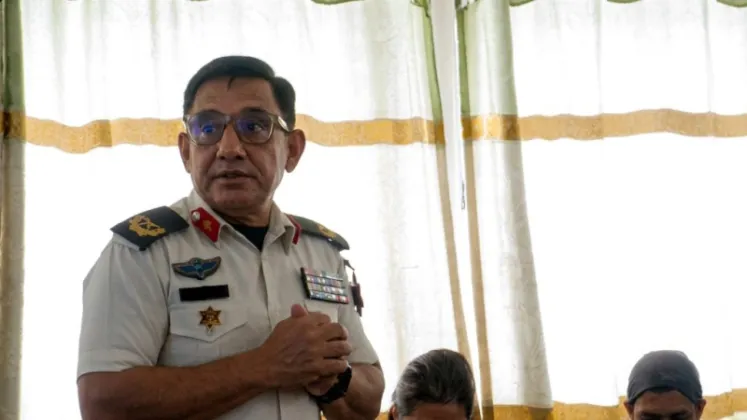
The Nepali Army has urged the establishment of a single, unified chain of command for disaster management in Nepal, warning that overlapping jurisdiction among government agencies is making coordination during emergencies increasingly difficult. Brigadier General Subash Jung Thapa delivered the Army's message while briefing the Parliamentary Special Committee under the House of Representatives in Kathmandu on Friday, saying that dual command is hindering disaster response. The Army's call comes in the aftermath of the Budhigandaki flood, which has sharpened attention on how Nepal's institutions work together when disaster strikes, and where those arrangements fall short.
'Dual command' is slowing the response, Army tells lawmakers
The core of the Army's briefing was a blunt diagnosis centered on authority rather than capability. Speaking to the committee, Brigadier General Thapa said dual command is hindering disaster response, a reference to situations in which more than one authority can issue instructions during a single operation. In such conditions, decisions on rescue, relief and the deployment of resources risk being delayed, duplicated or contradicted before they reach the people who need them most.
The setting of the remarks carried weight. The Parliamentary Special Committee is one of the mechanisms through which the House of Representatives scrutinises the country's security and administrative apparatus, and the Army used that platform to make its case directly to lawmakers. By taking the argument to Parliament, the institution appeared to signal that it views the command problem not as a minor operational hiccup but as a structural issue that requires a political decision.
Overlapping jurisdiction compounds the problem
Alongside the complaint about dual command, the Army said that overlapping jurisdiction among government agencies has made coordination more difficult. The two issues are closely related. When several bodies hold mandates that touch the same emergency, every operation raises questions about which institution leads, which follows, and who ultimately answers for the outcome.
The Army's argument, in effect, is that coordination is not merely a matter of goodwill or routine meetings: it depends on a clear hierarchy that tells every participating agency where it stands. Without a single chain of command, information and instructions must be reconciled across multiple lines of authority, adding friction precisely at the moment when time matters most.
Budhigandaki flood puts coordination under the microscope
The appeal comes in the aftermath of the Budhigandaki flood, and the connection is not incidental. The Army's message to the committee was framed by that experience: a major flood, a response involving multiple authorities, and, in the institution's telling, a command arrangement that made the work harder than it needed to be.
By invoking the Budhigandaki flood while asking for systemic change, the Army effectively argued that the problem revealed by that disaster will recur with the next one unless the underlying command structure is fixed. That is the crux of its appeal: a unified chain of command established in advance, so that the question of who is in charge is settled before the next emergency, not during it.
What a unified command would mean
The remedy the Army seeks is a unified chain of command for disaster management. In practice, such an arrangement designates a single lead authority through which decisions flow, giving every other participating agency a defined place in the structure. The intended benefits are straightforward: faster decisions, clearer accountability and less duplication of effort in the critical early hours of a disaster.
Key points from the Army's briefing to the parliamentary committee:
- A single, unified chain of command should govern disaster management operations.
- Dual command is hindering disaster response, according to Brigadier General Subash Jung Thapa.
- Overlapping jurisdiction among government agencies has made coordination more difficult.
- The appeal was made in the aftermath of the Budhigandaki flood.
- The briefing took place in Kathmandu on Friday before the Parliamentary Special Committee under the House of Representatives.
What happens next
The Army's briefing now places the question squarely before Nepal's lawmakers. The committee heard the Army's assessment on Friday; what it does with that assessment, and whether the government moves to restructure disaster response around a single command, remain to be seen. For the Army, the position laid out by Brigadier General Thapa was unambiguous: until the chain of command is unified, coordination among agencies will remain harder than it should be at exactly the moment it matters most.
The details of the briefing were reported by Onlinekhabar.


