
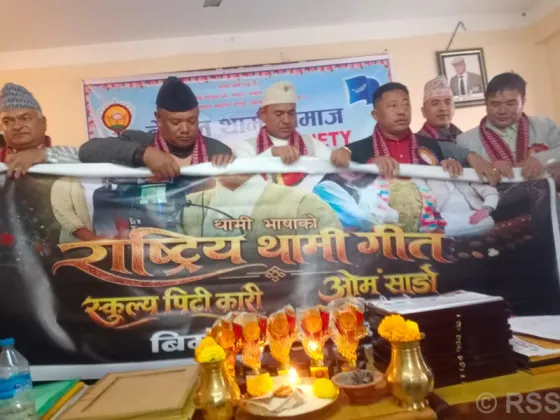
The Nepal Thami Society has released a national song prepared for the first time in the Thami language, unveiling the composition at its 27th annual general assembly in Kathmandu. The song was made public today during the gathering, turning the society's flagship yearly event into the setting for what is being described as a landmark moment for the Thami language and its place in Nepal's cultural life.
A First for the Thami Language
The release marks the first occasion on which a national song has been prepared in the Thami language. The debut was reserved for the annual general assembly, the event the Nepal Thami Society convenes each year to bring together its members and well-wishers, and this year's gathering was its 27th.
The Thami are recognised as one of Nepal's indigenous nationalities, and their language stands among the many mother tongues spoken across the country. Preparing a national song in the language gives the community a musical work of its own that can be shared at a national scale.
For an institution that has now held its annual assembly for more than a quarter of a century, the decision to place the song at the centre of the programme carried symbolic weight. Instead of limiting the occasion to routine organisational business, the society used the assembly to present a finished creative work in the community's own mother tongue, offering it first to the audience gathered in the capital.
Dignitaries Present at the Unveiling
The event drew guests from across Nepal's political and institutional spectrum. Those present included:
- Thula Thami, a member of the Bagmati Provincial Assembly
- Arjun Prasad Shivakoti, chairperson of Kalinchok Rural Municipality
- A representative of the Nepal Indigenous Nationalities Federation, the umbrella body of the country's indigenous nationalities movement
The mix of attendees underlined the range of support the initiative enjoyed. A provincial lawmaker's presence tied the release to Bagmati Province's political leadership, the rural municipality chairperson's attendance reflected engagement from the local government tier, and the federation's participation placed the event firmly within the wider national movement for indigenous language and cultural rights.
Why a National Song in the Mother Tongue Matters
Songs hold a particular power in the life of any language. They are short, memorable and easily repeated, and they travel naturally into schools, festivals, community gatherings and family celebrations. A national song in Thami gives the community a shared musical text in its own words, one that can be performed at public occasions and passed on to children in a form they can carry with them.
Mother tongues with smaller speaker bases often come under pressure as everyday communication shifts toward dominant languages in education, administration and the media. Cultural works such as songs, poems and recorded music are widely seen as practical tools against that drift, because they give a language a living presence in celebrations and shared moments rather than leaving it to formal texts alone.
The release also makes a statement about where the language belongs. Preparing a national song in Thami presents the language as fit for formal, public and ceremonial use, not only for private or domestic settings. That framing matters in Nepal, where the constitution recognises all mother tongues spoken in the country as national languages and where community organisations have long worked to move indigenous languages from the margins into schools, media and public ceremony.
Language, Memory and Identity
For members of the community, a song in their own tongue can serve as a point of pride and a marker of identity that is easy to summon and share.Performed at assemblies, cultural programmes and public celebrations, such a work helps ensure that the language is heard, sung and remembered by successive generations.
Community and State on the Same Stage
The 27th annual general assembly thus served two purposes at once. It remained, as in previous years, the society's principal occasion for convening its members, and it doubled as the venue for a cultural debut with significance well beyond the organisation itself.
The gathering also illustrated how language preservation in Nepal often advances through cooperation between community institutions and the state. The presence of a provincial assembly member, a rural municipality chairperson and a federation representative on the same stage as a community society showed the different levels at which support for mother-tongue initiatives can converge, from local government to provincial politics to the national indigenous movement.
A Milestone for Cultural Preservation
The society has not, in available reporting, announced further plans connected to the song. What the release has already accomplished, however, is concrete: the Thami language now has a national song, prepared for the first time and formally presented in a public, institutional setting.
The staging of the debut in Kathmandu, before an audience that included elected representatives and federation officials, ensured that the song's first public moment was also a moment of visibility for the language itself.
Details of the release were carried by Rato Pati and Gorkhapatra Online, both of which reported the unveiling at the Kathmandu assembly and the attendance of the provincial, local and federation representatives. For the Thami community, the composition now stands as a cultural artefact in its own language, debuted at an assembly that has anchored the society's life for 27 years.


