
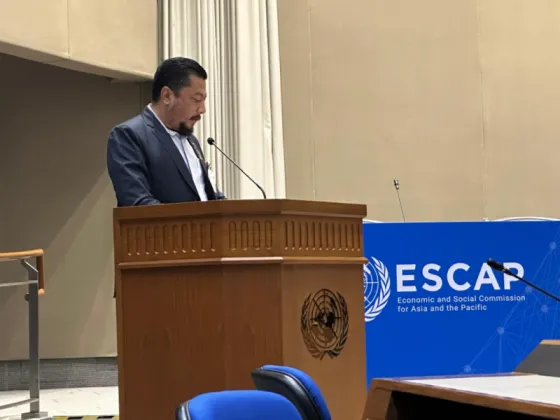
Minister for Energy, Water Resources and Irrigation Birajbhakta Shrestha has urged the international community to join hands in protecting the Himalayas, declaring at a high-level regional dialogue in Bangkok that the climate crisis unfolding in the mountain region cannot be contained within any single country's borders. Speaking at 'From Sagarmatha to the Sea', a dialogue jointly organised by the United Nations Economic and Social Commission for Asia and the Pacific (UNESCAP) and the Government of Nepal, Shrestha presented four proposals on behalf of Nepal, and all four secured the support of 53 countries, according to reports by Nepal Press and Nagarik News. The sweeping endorsement handed Nepal's climate diplomacy a notable lift and underscored how widely the argument for collective mountain protection resonated among participating nations.
The climate crisis stops at no border
Shrestha's central message to the Bangkok gathering was direct: the environmental emergency taking shape in the Himalayas is not one country's problem alone, and it cannot be solved by one country alone. The climate crisis in the Himalayan region, he told delegates, is not confined within any single country's borders, and he called for global cooperation to protect the mountains.
The title of the dialogue itself captures the reasoning behind that appeal. Sagarmatha, the Nepali name for Mount Everest, stands at the head of an ecological and hydrological chain that links the glaciers of the high Himalayas to river systems, plains and, ultimately, the sea. By framing the conversation "from Sagarmatha to the Sea", the organisers placed the mountains and the ocean within a single narrative of shared vulnerability. For Nepal, which sits at the centre of that chain, the forum offered an opportunity to argue that the fate of the mountains and the fate of downstream communities are inseparable, and that safeguarding one demands the engagement of all.
Four proposals and backing from 53 countries
Nepal's delegation did not arrive in Bangkok with rhetoric alone. Shrestha formally tabled four proposals on behalf of the country during the dialogue, placing Nepal's positions before a regional audience of governments and UNESCAP member states. The response was emphatic: the proposals received support from 53 countries, a level of endorsement that few national submissions at such forums manage to secure.
That backing carries weight beyond symbolism. Broad regional support signals that the concerns Nepal raised are shared across the Asia-Pacific, and it strengthens the case for carrying those proposals forward into concrete cooperation frameworks. For a country whose development prospects and disaster risks are tied directly to the health of its mountain environment, validation from dozens of nations gives Kathmandu added standing in future climate discussions.
Among the themes Shrestha emphasised during his Bangkok engagements were:
- Global cooperation to protect the Himalayas, on the grounds that the climate crisis does not respect national borders
- Regional cooperation as the practical mechanism for tackling shared climate and geo-disaster risks
- The use of space technology to strengthen disaster preparedness and response
- Data sharing among countries so that emerging risks can be identified and addressed early
Space technology as an early-warning tool
In a related engagement, Shrestha also addressed the fifth ministerial conference on space applications for sustainable development in Asia and the Pacific, where the discussion shifted from diplomacy to the practical tools available for confronting climate and geo-disaster risks. There, he stressed the use of space technology, data sharing and stronger regional cooperation as essential elements in reducing those risks.
The emphasis reflects a growing recognition among governments in the region that satellites and space-based data can do what ground-based systems alone cannot: observe vast, remote and often inaccessible terrain continuously. For Nepal, whose rugged topography makes monitoring difficult and costly, space-based applications offer a way to keep watch over environmental change and to anticipate hazards before they strike. Shrestha's call for data sharing sits at the heart of this argument, since climate and geological risks frequently develop across areas that span national boundaries, and an early warning is only as strong as the information that flows between neighbouring countries.
A message aimed at the region and beyond
Taken together, Shrestha's interventions in Bangkok delivered a coherent two-part message: protect the Himalayas through global solidarity, and prepare for the risks that remain through regional cooperation and modern technology. His formulation, as reported by Gorkhapatra Online, was straightforward: let us use regional cooperation and technology to combat climate and geo-disasters.
The 53-country endorsement of Nepal's proposals suggests that the message found a receptive audience. At a time when the impacts of climate change increasingly disregard the lines drawn on maps, Nepal's appeal from Bangkok was for the world's response to disregard them as well.


