
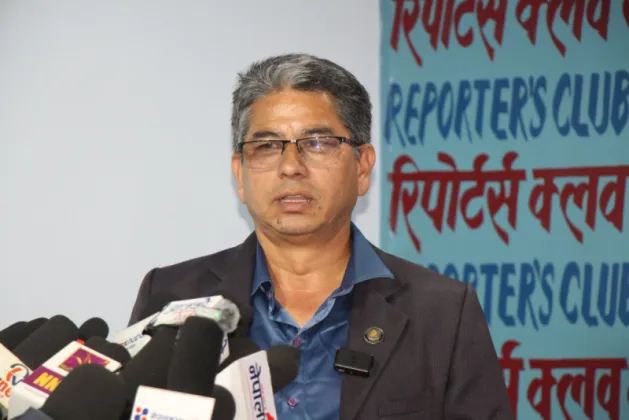
The Law, Justice and Human Rights Committee of Nepal's House of Representatives has called a meeting for next Tuesday at Singha Durbar to discuss the controversy surrounding a Supreme Court judge who allegedly maintained a relationship and exchanged messages with Inam Sapkota, an alleged middleman. Rastriya Swatantra Party (RSP) lawmaker Madhukumar Chaulagain confirmed that the committee will examine the matter, while his party colleague Rajiv Khatri went a step further, saying impeachment proceedings against the judges should be considered. The development places the issue squarely on Parliament's agenda and signals that the RSP is preparing to push for decisive action, including a possible impeachment motion.
Committee summons meeting over judge controversy
According to reports by News of Nepal, the parliamentary committee has scheduled the meeting for next Tuesday at Singha Durbar, the complex in Kathmandu that houses the federal parliament. The meeting has been called specifically to discuss the controversy that has enveloped the Supreme Court judge following revelations about the judge's relationship with Sapkota and the exchange of messages between the two.
Chaulagain, who represents the RSP, said the committee meeting will examine the matter in detail. By placing the issue on its agenda, the Law, Justice and Human Rights Committee - the parliamentary body that oversees matters relating to the courts, legal affairs and human rights - is ensuring that the controversy will be formally debated within the legislature rather than remaining confined to media reports and political chatter.
The decision to summon the meeting reflects mounting concern among lawmakers over allegations that a middleman had direct access to a sitting judge of the country's highest court. The exchange of messages between the judge and Sapkota has become the focal point of the dispute, and lawmakers are expected to scrutinize what those communications suggest about the judge's conduct.
RSP lawmakers push for impeachment
The strongest signals so far have come from the RSP, whose lawmakers have made the judge controversy a talking point in the House of Representatives. Summarizing the party's position:
- Madhukumar Chaulagain said the committee meeting will examine the Supreme Court judge controversy, and added that the party is discussing an impeachment motion and would act firmly to end middleman influence in the judiciary.
- Rajiv Khatri said impeachment proceedings against the judges should be considered, framing the controversy as serious enough to warrant constitutional action.
The party's rhetoric has been combative. As reported by Nepal Press, an RSP lawmaker said of the Inam Sapkota case that the party will be ruthless in pursuing the matter even if it has to investigate the Prime Minister's Secretariat. The remark indicates that the RSP views the alleged middleman network as potentially reaching beyond the judiciary into the highest offices of the state, and that the party is prepared to keep pressing the issue regardless of where it leads.
The discussion of an impeachment motion marks a significant escalation. An impeachment process against Supreme Court judges is a rare and weighty step, and the fact that ruling-side and opposition-adjacent voices within the RSP are openly debating it underscores how seriously the party is treating the allegations. Chaulagain's insistence that the party would act firmly to end middleman influence in the judiciary suggests the RSP intends to keep the pressure on both in the committee and, if necessary, on the floor of the House.
The Inam Sapkota controversy at the center
The controversy revolves around Inam Sapkota, described as an alleged middleman, and the relationship he maintained with a Supreme Court judge, including messages the two exchanged. The term middleman carries particular weight in Nepal's current political discourse, where brokers are frequently accused of facilitating improper outcomes by exploiting their connections to people in positions of power.
The allegation that a sitting judge of the Supreme Court - the institution responsible for safeguarding the constitution and delivering final justice - had personal contact with such a figure has struck a nerve. For the RSP, which has positioned the issue as a battle against middleman influence in the judiciary, the case represents exactly the kind of entrenched nexus between brokers and state institutions that the party has promised to confront.
The committee meeting next Tuesday will be the first formal parliamentary venue in which the allegations are examined. Lawmakers are expected to seek clarity on the nature of the judge's relationship with Sapkota and the content and significance of the messages exchanged between them. The judge at the center of the row has not been named in the committee's announcement or in the accompanying media reports.
What happens next
Attention now turns to Tuesday's meeting at Singha Durbar. The outcome of the committee's deliberations could determine whether the controversy remains a subject of parliamentary scrutiny or matures into a formal impeachment motion in the House of Representatives, as Khatri has advocated and as Chaulagain says the RSP is actively discussing.
For the judiciary, the episode represents one of the most direct challenges from Parliament in recent memory. For the RSP, it is a test of the party's declared resolve to be ruthless in uprooting middleman influence, wherever it is found. With the committee set to convene and impeachment talk gaining ground, the coming week is likely to determine how far - and how fast - the Inam Sapkota affair travels through Nepal's political and judicial institutions.


