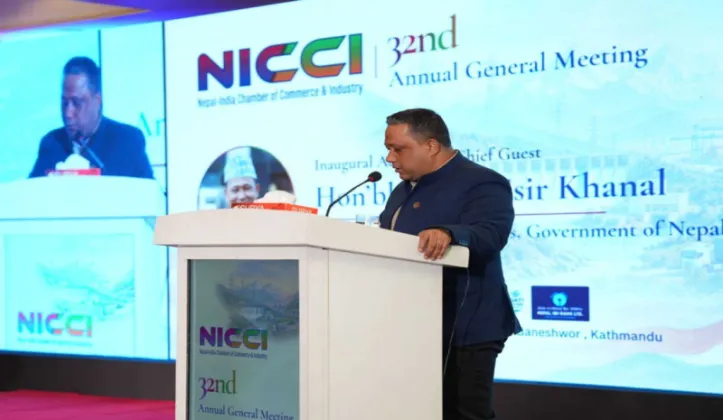
Foreign Minister Shishir Khanal on Thursday called for Nepal and India to strengthen economic cooperation and make air connectivity more effective, addressing the 32nd annual general meeting of the Nepal-India Chamber of Commerce and Industry (NICCI) in Kathmandu. He said the neighbours must move beyond a situation of “open borders but closed skies” and prioritise economic diplomacy to turn bilateral potential into concrete gains.
Air connectivity and economic diplomacy
Khanal’s remarks highlighted air connectivity as an important part of a wider effort to make Nepal-India relations more productive, diversified and sustainable. While describing the contrast between open borders and closed skies, he urged the two countries to make air links effective. His call placed connectivity alongside trade, investment, energy, digital technology and tourism as areas where closer cooperation could support stronger economic ties.
The minister stressed that economic diplomacy should be given priority in managing and advancing the bilateral relationship. The aim, as he described it, is not simply to recognise the scope for cooperation but to translate that potential into tangible economic benefits. His message to the NICCI gathering focused on making the relationship deliver more practical outcomes across several sectors.
Cooperation across key sectors
Trade and investment were among the areas Khanal identified for expanded cooperation. Stronger engagement in these fields, alongside energy, digital technology and tourism, would help broaden the economic relationship beyond a narrow set of interests. By naming a range of sectors, he called for a more diversified approach to Nepal-India ties.
The emphasis on multiple areas also reflected his call for bilateral relations to be sustainable as well as productive. Khanal linked that goal to economic diplomacy and to the need to turn opportunities into concrete gains. He did not present the relationship as an issue for a single sector; instead, his remarks pointed to a broad agenda involving connectivity and cooperation across economic activity.
NICCI meeting highlights bilateral agenda
Khanal delivered the remarks at NICCI’s 32nd annual general meeting in Kathmandu, a gathering centred on Nepal-India commercial relations. His address brought the chamber’s economic focus into a wider discussion of bilateral ties, with air connectivity and cooperation in key sectors presented as priorities for stronger engagement between the neighbours.
The call to make air connectivity effective was a central part of the address, encapsulated in the phrase “open borders but closed skies.” Khanal’s formulation drew attention to the contrast he sees between the openness of the land border and the need to improve air links. He urged action on connectivity as part of a broader effort to make economic relations more useful and responsive to the opportunities he identified.
Turning potential into concrete gains
Khanal’s appeal was ultimately for Nepal and India to make their economic relationship more results-oriented. He said economic diplomacy should help convert potential into concrete economic gains while supporting ties that are diversified and sustainable. The sectors he highlighted - trade, investment, energy, digital technology and tourism - set out the breadth of cooperation he wants the two countries to pursue.
The address at the NICCI meeting therefore combined a specific connectivity message with a wider call to deepen economic engagement. Khanal urged Nepal and India to make air connectivity effective and to expand cooperation across the named sectors, with economic diplomacy serving as a priority. His central point was that stronger bilateral ties should be reflected in practical outcomes, rather than remaining only a statement of potential.