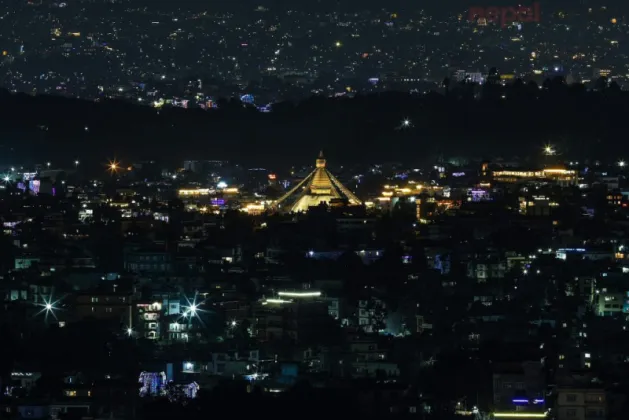
Nepal imported decorative lights worth Rs 645.2 million in the first three months of the current fiscal year 2083/84, a festive-season surge driven by demand ahead of Tihar, the festival of lights that illuminates homes, shops and streets across the country every autumn. According to Department of Customs data, 2.859 million units of decorative lights were brought into the country through the Nepali month of Ashwin as traders built up stocks for the celebrations. In the same period of the previous fiscal year, imports stood at Rs 596.5 million for a noticeably larger 3.892 million units, meaning Nepal paid more this year even as it brought in fewer lights.
Fewer units, a bigger bill
The year-on-year comparison in the customs figures reveals a clear shift in the decorative lights trade. In value terms, the import bill grew by about Rs 48.7 million, an increase of roughly 8 per cent over the Rs 596.5 million recorded during the first three months of the last fiscal year.
In volume terms, however, the trend moved in the opposite direction. The 2.859 million units imported through Ashwin this year represent a fall of more than 1.03 million units, or around 26 per cent, compared with the 3.892 million units brought in during the same period a year earlier.
Put together, the two sets of numbers point to a sharp rise in the average price of the lights entering the country. The average value per imported unit climbed from about Rs 153 last year to roughly Rs 226 this year, an increase of nearly 47 per cent.
A quick comparison of the two festive seasons:
- This fiscal year (through Ashwin): Rs 645.2 million spent on 2.859 million units
- Last fiscal year (same period): Rs 596.5 million spent on 3.892 million units
- Change in value: up about 8 per cent
- Change in volume: down about 26 per cent
Tihar's appetite for light
The import surge is closely tied to the calendar of Nepal's most luminous festival. Tihar, celebrated over five days in the Nepali month of Kartik, transforms the country into a canvas of light: households hang decorative lighting along balconies and doorways, shopkeepers illuminate their storefronts, and streets in cities and towns glow throughout the festivities.
Demand is at its most intense around Laxmi Puja, the day when businesses and homes are cleaned, decorated and lit up to welcome the goddess of wealth. Traditional oil lamps and candles share space with electric string lights, making the weeks leading up to the festival the busiest selling season for lighting products.
The timing of the customs figures reflects that rhythm. The first three months of the fiscal year, spanning Shrawan, Bhadra and Ashwin, capture the period when importers and retailers place their orders and fill their warehouses so that lights reach the market in time for the festival shopping rush. Ashwin, which falls in September-October, sits immediately before the Tihar season, making it a decisive month for festive imports. As Arthasarokar noted in its report, the lights worth Rs 64.5 crore were brought in specifically targeting the festival.
Festive consumption in the customs ledger
The Department of Customs data offers one of the clearest windows into how festivals shape Nepal's import patterns. Decorative lights are a small but highly visible slice of the country's trade, spiking sharply in the months before Tihar and tapering off once the celebrations end.
The figures for the current fiscal year suggest that festive demand remains strong. Importers spent more in value terms than last year even as the number of units declined, a combination that points to costlier consignments arriving at the border this season. What lies behind that price movement, whether a shift toward more elaborate products or a change in the import mix, cannot be determined from the headline numbers alone.
What the data does confirm is the scale of the seasonal market. More than 2.8 million units of decorative lights entered the country in a single quarter, all timed to meet the demand that builds as Tihar approaches. For traders, the quarter through Ashwin is the make-or-break stretch of the year for the lighting business. For the customs ledger, it is a recurring marker of festival-driven consumption in Nepal's import profile, one that news reports tracking the festive economy highlight each year as the country gears up for its brightest celebration.